Workshops
The Japanese Nō theatre
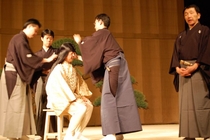
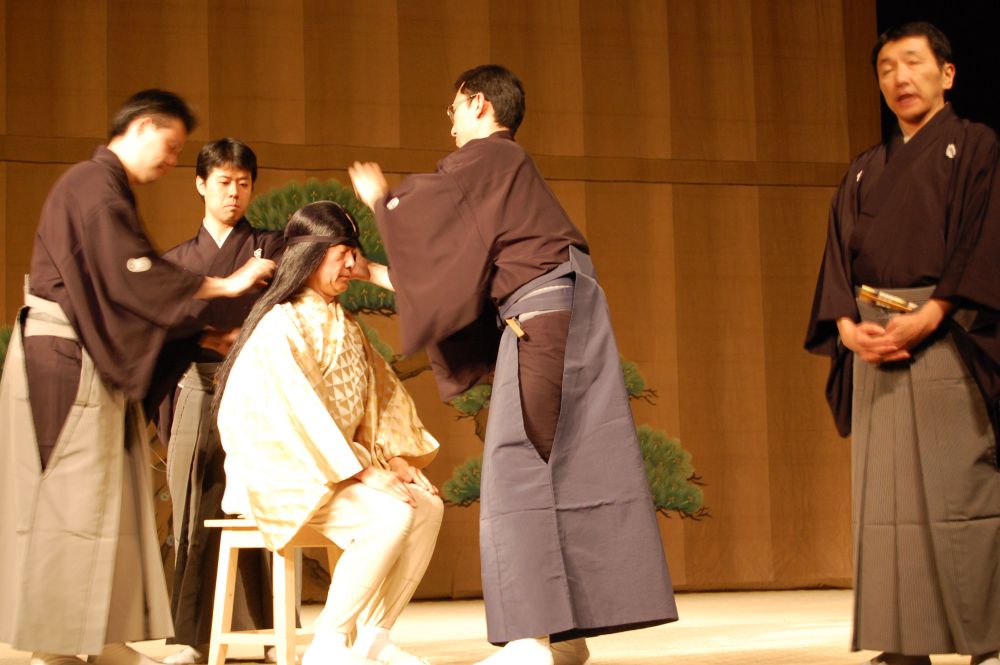
Performers: the shite-kata specialists Yaemon Yamashina and Yoshito Sekine (leading actors - shite in the kanze style) and the kyogen-kata specialists Takashi Zenchiku, Noriyoshi Okura (kyogenactors in the Ohkura style) and Ryuhei Zenchiku (kyogen actor in the Ohkura style and Nō master)
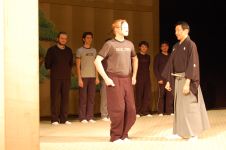
Participants: Alexandru Nedelcu, Eduard Adam, Florin Lazarescu, Axel Moustache, Răzvan Hîncu, Mihai Calota, Richard Bovnoczki, Relu Poalelungi, Vlad Logigan, Radu Iacoban, Adrian Nicolae, Radu Micu, Ioan Cortea, Şerban Gomoi
Time: between the 6th and 7th of February, 2009
Location: The National Theatre of Bucharest
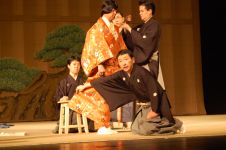
The Nō theatre (with serious topics) and the Kyogen theatre (with humorous topics) were known until the Modern Age as sarugaku, while in the Japanese of today they are called nogaku. With roots that date back in the Nara Period (710-794), sarugaku became, in the Middle Age, an aesthetically valuable art with the help of Zeami (1363-1443), who was an actor, a playwright and a theoretician of the Yamato Sarugaku Company. From the beginning Nō and Kyogen were performed together. In the Middle Age, they were performed in temples, during the religious festivals but in the following ages, and especially in the Modern Age, they became a type of cult theatre, with secular character. The square stage with supporting poles for the roof is specific to the Nō theatre. On the left there is a bridge called hashigakari. Initially, the stage did not have a roof and the hashigakari was in the middle of the background. The current shape was adopted in the 16th century. During the Nō plays the choir was placed on the right while the instrumentalists in the background. The actors use the front and the left half of the stage, trying to avoid both the right one and the background. In Japan, the scene and roof are placed inside a normal hall with its own ceiling. The stage is separated from the audience's seats by a layer of white pebbles. The workshop held at Bucharest for two days, was an introduction to the structure and specificity of this type of theatre, with the purpose of making a demonstration and initiating the performers the techniques of the Nō actors. The workshop was organised in collaboration with the Embassy of Japan in Romania.