Conferences
Acad. Valeriu Matei: A Quarter Century of Returning to Linguistic and Cultural Normality in Bassarabia (Republic of Moldova)
16 lei
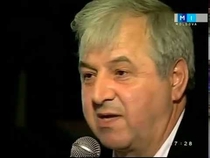
On Sunday, September 14, 2014, at 11 a.m., Academy member Valeriu Matei will be hosting the conference titled A Quarter Century of Returning to Linguistic and Cultural Normality in Bassarabia (the Republic of Moldova) in the Media Hall. The price of a ticket is 16 lei.
About the Conference
With the occasion of the Mihai Eminescu National Theatre in Chișinău tour, which will arrive on the stage of the National Theatre in Bucharest, Mr. Valeriu Matei, a well-known Bessarabian writer and politician, a member of the Academy of Sciences in the Republic of Moldova and an honorary member of the Romanian Academy, will be hosting a conference about the linguistic unity of the entire Romanian area, which includes Bessarabia.
Twenty-five years after the abolishment of the Cyrillic alphabet and after making the switch to the Latin alphabet, the Republic of Moldova has celebrated, on August 31, the holiday “Our Romanian Language”. This is the first time when the Romanian language is called an official language, thus replacing the phrase “Moldavian language”.
Valeriu Matei promises “a unique conference, based on points of view which do not fit the mould”, a plea in the defence of the Romanian language.
An album dedicated to the history of the National Theatre in Chișinău will be released at the end of the conference.
About Academy member Valeriu Matei
Valeriu Matei (born on March 31, 1959, in Cazangic, the Leova district) is a poet, historian, writer and politician from the Republic of Moldova, a member of the Academy of Sciences of Moldova and an honorary member of the Romanian Academy since 2011. He was a candidate in the Moldovan presidential election in 1996. He has been a director of the Romanian Cultural Institute in Chișinău since 2013.
Between 1976 and 1979 he was a student at the Moldova State University, the Faculty of History. Between 1979 and 1983 he studied at the Lomonosov Moscow State University, in the Ethnology Department of the Faculty of History, which he eminently graduated.
He made his mature debut in 1980 by publishing poetry in the Tineretul Moldovei newspaper in Chișinău. In 1981 he published poetry in the Romanian literary press (Orizont, Timişoara, Luceafărul, Bucharest, Cronica and Convorbiri literare, Iaşi, Tribuna and Steaua, Cluj-Napoca, Transilvania, Sibiu, Familia, Oradea).
In 1983 he was rejected from obtaining a doctorate for reasons of anti-Sovietism and nationalism. With the support of some of his University colleagues and the Ethnology Department professors, he managed to obtain a job as a minor scientific researcher, with the lowest salary in the system, at the Land Studies Museum in Istra, where he remained until 1987. In 1985, after five years of being swept under the rug, his poetry was published (although truncated) in the literary press in Chișinău.
He was one of the protagonists of the events which took place at the Writers’ Union of Moldova between March and May 1987, events which laid the foundation of the Democratic Movement of Moldova. Between May 1987 and March 1990, he represented the Writers’ Union of Moldova at the secretariat of the Writers’ Union in Moscow. He was not a member of the Communist Party. In 1989 he participated at the formation of the Popular Front of Moldova. He was a speaker for the organisation and a member of its Executive Office. In 1990 he was elected a deputy in the Parliament of the Republic of Moldova in the Leova district. He was a president of the Parliamentary Committee for Mass-Media (1990-1993), a member of the Presidium of the Parliament. He was re-elected as a deputy in the Parliament of the Republic of Moldova (1994-2001) on the lists of the Democratic Forces Party, whose president he was (1994-2002). He was a candidate in the presidential election in the Republic of Moldova in 1996. He obtained 9% of the votes. He was a vice-president of the Parliament (1998-1999), a president of the EU-Moldova Parliamentary Cooperation Committee (1998-2001).
He is the author of several poetry books (which have been published in Chișinău, Iași and Bucharest), a theatre play titled “The Prologue” (staged at the Mihai Eminescu National Theatre in Chișinău in 1987), the historical short story “The Pilgrimages and Suffering of Chancellor Nicolae Milescu” (1988), several essays and history and ethnology studies (“The Molotov-Ribbentrop Pact and the Soviet Aggression Against Romania”, 2012). He has translated poetry from French (Arthur Rimbaud and others), Russian (Osip Mandelstam, Anna Akhmatova), Spanish (Federico Garcia Lorca). His poetry has been translated in English, French, German, Spanish, Russian, Greek, Swedish, Latvian, Slovak, Hungarian, Macedonian, Turkish, etc.
Awards and honours: the Nichita Stănescu Grand Award (1995), the Mihai Eminescu Award of the Romanian Academy (1996), the Mihai Eminescu Medal (2000), the Nichita Stănescu Grand Award for Opera Omnia (2002), the Poesis Award (2007), the Writers’ Union of Moldova Award (2008, 2010), the Order of the Star of Romania in the rank of Commodore (2004), the Order of the Republic (2010).
The release of the Anniversary Album of the Mihai Eminescu Theatre in Chișinăuwill take place within the conference.
Translated by Diana-Crezante Raicev
MTTLC, University of Bucharest