Events
“The Sonic Turn” International Conference
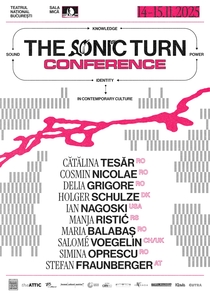
The international conference "The Sonic Turn" investigates sound and the act of listening, on November 14 and 15, 2025, in the Small Hall of the National Theater of Bucharest.
The Attic platform launches The Sonic Turn, an interdisciplinary initiative that places sound at the center of understanding contemporary cultural and socio-political phenomena.
The project focuses on a paradigm shift that is increasingly present in international research and public discourse: understanding and using sound as a tool for knowledge and critical reflection. This reorientation positions sound as a critical mode of investigation, a material force, and a site of power. Through debates, presentations, discussions, concerts, articles, and podcasts, "The Sonic Turn" opens a dialogue about the role that acoustic experiences play in the configuration and deconstruction of memory, identity, and the social body.
On November 14 and 15, 2025, The Attic presents the international conference The Sonic Turn in the Small Hall of the National Theater in Bucharest. Theorists, anthropologists, artists, and ethnomusicologists will gather for two days to explore the cultural, political, and ecological dimensions of sound and listening through presentations, performances, and discussions. The Sonic Turn brings together several Romanian and international guests, each with a unique practice in the field of sound studies and related arts: Catalina Tesar (RO), Cosmin Nicolae (RO), Delia Grigore (RO), Holger Schulze (DE), Ian Nagoski (USA), Manja Ristić (RS), Maria Balabas (RO), Salomé Voegelin (CH/UK), Simina Oprescu (RO) and Stefan Fraunberger (AT). In addition, the conference program will include a discussion curated by the Iscoada platform on the topic of sonic surveillance in techno-feudalism: "Who is listening to whom and for what purpose? Sound as an instrument of control."
From the aesthetics and politics of the sound of war to listening as a decolonial practice, from collective memory to cultural identity and sonic activism, the presentations open up new perspectives on sound studies, and the performances invite the audience to listen to and perceive socio-cultural phenomena from new angles. There will be critical discussions about the role of sound in society, its political and ecological dimensions, as well as memory, identity, and surveillance. Participants will have the opportunity to discover diverse voices and practices, take part in interdisciplinary dialogues, and experience sound as a medium for research, expression, and cultural resistance.
Between September 2025 and January 2026, The Attic will publish a series of articles and podcast episodes exploring the subject of sound from the perspectives of artists, journalists, and researchers invited to contribute. The materials explore from multiple perspectives how sound shapes cultural, social, and political experiences.
By opening up to the general public and through academic input, "The Sonic Turn" aims to deepen our understanding of how we listen, stimulate critical reflection, and position Bucharest in the international circuit of debates on sound, memory, and identity in contemporary culture. Together, we ask ourselves: what does it mean to think with and through sound today—and what would the future look and sound like with this renewed attention to sound?
Information about tickets will be available soon.
The Sonic Turn is a cultural project co-funded by the National Cultural Fund Administration. The project does not necessarily represent the position of the National Cultural Fund Administration. AFCN is not responsible for the content of the project or how the results of the project may be used. These are entirely the responsibility of the funding beneficiary.
Location: Bucharest National Theater (Small Hall)
Partners: Austrian Cultural Institute, Goethe Institute, CIMRO
Media partners: Iscoada, IQAds, Antropedia, Utopia Balcanica, Cutra
Website: www.theatticmag.com
Facebook: facebook.com/theatticmag
Instagram: instagram.com/the.attic.magazine
Translated by Andreea Codrea-Boeriu