Current Repertory
The Winter’s Tale
by William Shakespeare
The Winter’s Tale
by William Shakespeare
Pause: No
First-Year Acting Masterclass Performance, presented in partnership with the “I. L. Caragiale” National University of Theater and Cinematography
William Shakespeare’s “The Winter’s Tale” evokes optimism and overturns the conclusion of finality found in “Macbeth”: “What’s done is done” (Act V, Scene 1).
Shakespeare does exactly what we cannot do in reality: he stops history like water from a faucet and transports us to any moment other than the present. This time, Time turns toward final forgiveness. But can there be forgiveness in the end, and can the time spent atoning soothe the wound inflicted?
Blinded by jealousy born of the fear of losing a beautiful, eternal present, the King of Sicily—Leontes—ruins his own situation and that of those close to him: he falsely accuses his wife, Hermione, of betraying him with his best friend, Polixenes, King of Bohemia, believing he has clear proof, as Hermione is about to give birth to a child he is certain is not his.
At the beginning of the play, Mamillius, the young prince and son of Leontes, says—as if in a premonition—that winter tales are sad and full of strange events. Leontes himself will set strange events in motion by throwing Hermione into prison, where she will give birth to Perdita; by threatening Polixenes and his close associate, Camillo; and later, by banishing the newborn and his servant, Antigonus, into the wilderness. The conclusions toward which his actions lead are entirely negative: Mamilius dies, Hermiona dies, and Perdita is doomed. Again: how definitive are these conclusions? Yet sixteen years pass, and the characters are saved from a fate woven from madness: Perdita and Florizel, the son of Polixenes, fall in love. The second part of the play is a comedy in which the characters no longer live in moral absolutism: Perdita understands that love has nuances, while the Clown and Autolycus live only for momentary pleasure. Behind this comedy, a king will continue to traverse the nocturnal path of his conscience, blind to himself until the final revelation, orchestrated from the very beginning by Paulina. The ending is a return to the beginning, a turning inward that can make room for the revelation of the other.
Irina Alexandra Banea, director
Translated by Andreea Codrea-Boeriu
Buy tickets
*Accessing the "Buy tickets" button will redirect you to www.bilet.ro which will facilitate your tickets acquisition.
| The Small Hall | 19:00 | Buy tickets |
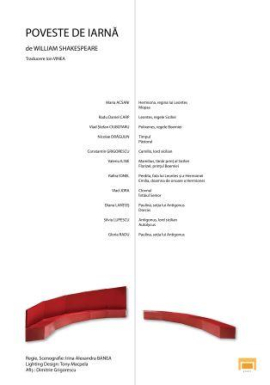
| Hermiona, Leontes′ Queen, Mopsa: | Maria Acsani | Leontes, King of Sicily: | Radu Daniel Carp |
| Polixenes, King of Bohemia: | Vlad Ștefan Ciubotaru | Time, the Shepherd: | Nicolae Drăgulin |
| Camillo, Sicilian nobleman: | Constantin Grigorescu | Mamilius, young Prince of Sicily: | Valeriu Ilisie |
| Florizel, Prince of Bohemia: | Valeriu Ilisie | Perdita, the daughter of Leontes and Hermione: | Rafira Ionel |
| Emilia, Hermione's maid of honor: | Rafira Ionel | The Clown, the First Elder: | Vlad Jora |
| Paulina, Antigonus's wife; Dorcas: | Diana Lanțoș | Antigonus, Sicilian nobleman; Autolycus: | Silviu Lupescu |
| Paulina, Antigonus's wife: | Gloria Radu |