Spectacles
Hurrah, Nosferatu! - NETA
by Andrej E. Skubic

Hurrah, Nosferatu! - NETA
by Andrej E. Skubic
Premiere: 29.08.2015
Pause: No
The performance will be presented in the NETA International Theatre Festival by Nova Gorica National Theatre, Ljubliana Youth Theater, Slovenia.
The show will have subtitles in romanian and english.
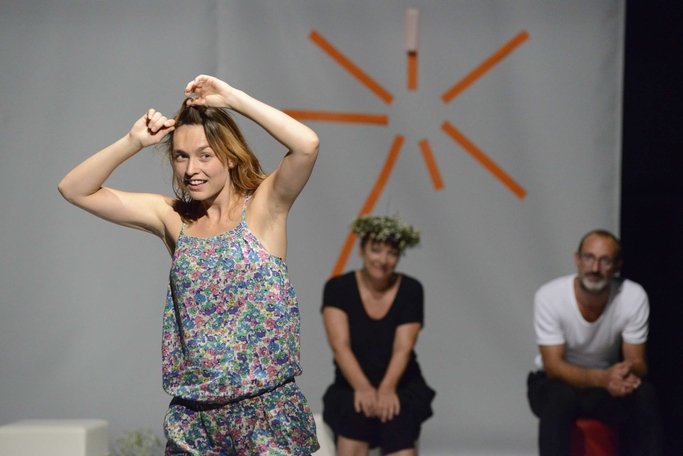
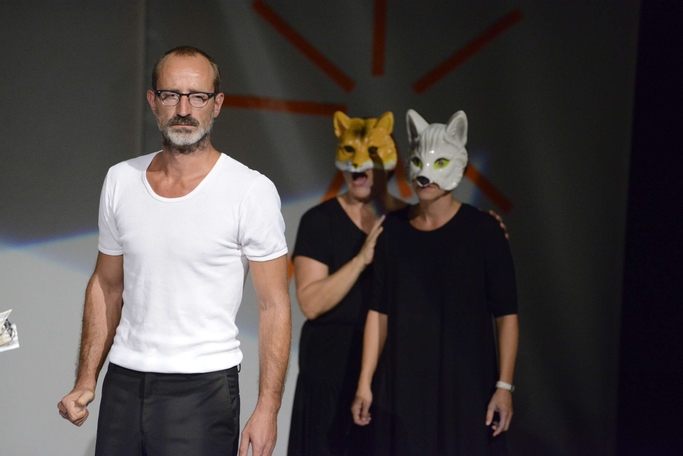
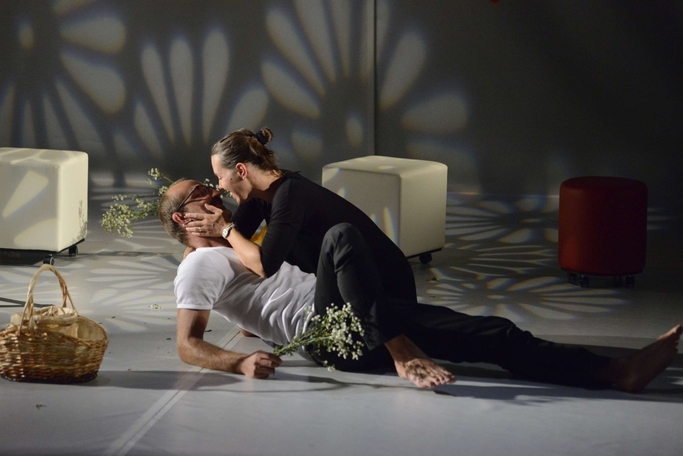
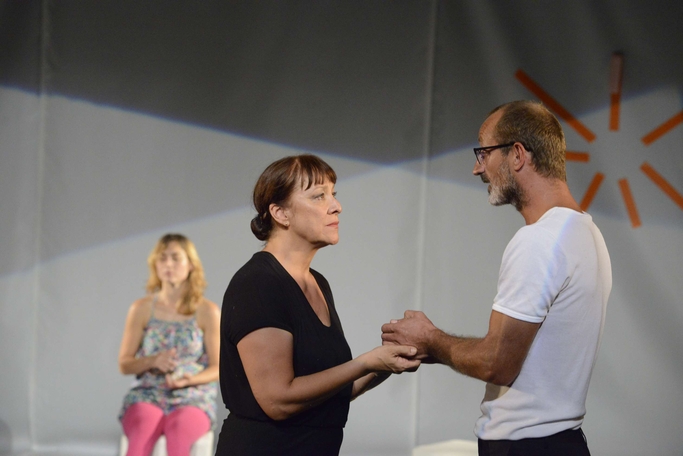
| Aleš : | Blaž Valič | Nataša : | Maja Nemec |
| Vida: | Arna Hadžialjević | Luka: | Boštjan Narat |
| Mother Marija: | Damjana Černe |
Interview with Andrej E. Skubic and Simona Semenič
With political correctness you get nowhere in serious life trials
The Prešeren Fund Award for the novel How Much Are You Mine? (Koliko si moja?, Beletrina, 2001), the Kresnik Award for the début novel Bitter Honey(Grenki med, DZS, 1999), How Much Are You Mine? andJust Come Home (Samo pridi domov, Modrijan, 2014), winning the Cankarjeva Založba competition for the best contemporary novel with Popcorn (Popkorn, Cankarjeva založba, 2006), the 2007 Župančič Award for Popcorn and the Sovre Award for the translations of Gertrude Stein: a Reader (Gertrude Stein: Čitanka) and the novel How Late It Was, How Late (Kako pozno, pozno je bilo) by James Kelman. Six novels, one short story collection, three plays, a scientific monograph Faces of the Language (Obrazi jezika, Beletrina, 2005), countless translations … the summary of the key milestones on the professional path of the writer, translator and playwright Andrej E. Skubic.
The Grum Award for the plays 5boys.si (2009), 24hours (2010) and seven cooks, four soldiers and three sophias (2015), award-winning performances in almost all Slovenian theatres, acclaimed performances abroad, the authorial projects I, the Victim (2007), 43 Happy endings (2010), The Second Time (2014), leading the Preglej playwriting lab and numerous (international) playwriting workshops, managing Glej Theatre, working as a dramaturg, as a producer … the summary of key milestones on the professional path of the playwright, dramaturg and performer Simona Semenič.
Hoorrah, Nosferatu is their first professional cooperation. They enter it in the – seemingly atypical – roles of the playwright and the director.
Andrej, we know you as a multi award-winning writer and translator, so far you have tackled drama three times; Countless Numbered Days (Neskončni šteti dnevi, SNG Nova Gorica, 2009), Hoorrah, Nosferatu! (Hura, Nosferatu!, (2007) – which won you the Grum Award nomination in 2009 and Pavla Above the Precipice (Pavla nad prepadom, Mladinsko Theatre, 2014). Where do you perceive the key differences between prose and drama, and does it influence your process of writing? Does the fact that a play is, in a way, a “half-baked product”, which requires a mediator before it comes to the addressee, present a special challenge?
Andrej: Well, of course I’ve always loved theatre, but it was so fabulously alien to me that I’ve never seriously thought to write for it. Prose, that sitting behind the computer in the intimacy of a room, was a lot closer to me than socialising with actors, directors, dramaturgs, stage designers … But the events around the staging of Fužine Blues (Fužinski bluz), performed at SNG Drama Ljubljana (2005) on Janez Pipan’s initiative, excited me to the point that I wanted to write a text that was totally mine. Truly banal: look, I write some lesbian fantasy scene in the novel and then SNG Drama casts two fantastic actresses, Aleksandra Balmazović and Saša Mihelčič to act it out? It doesn’t get better than that! But surely I can write something better! So I had to go on. Countless Numbered Days (Neskončni šteti dnevi)was then created as an adaptation of a short story into a play. Yes, letting the “half-baked product” go to other people, ones you have to trust, is a special kind of a challenge, but so far, thank god, it’s always been good … Particularly the staging of Pavla Above the Precipice knocked me over – in a good way, I mean – I had the feeling this wasn’t my text at all, that I was watching something completely new. It was only when I was translating the surtitles into English that I realised they hadn’t changed a thing, they had just cut less than a quarter … The contribution of the entire team was so immense that the performance went far beyond the text. This, to me, is the charm of writing for theatre.
Simona, we know you as a successful playwright with several awards, and although you have a number of performances behind you that you authored (Polna pest praznih rok / A Fistful of Empty Hands, 2001; Solo brez talona / Solo Without Talon, 2003; She Said, 2005; Iz Principa / Out, 2009; Kdo je naslednji / Who’s Next?, 2011, ...) and also many in which you also performed (Jaz, žrtev / I, the Victim; Drugič / The Second Time), we rarely meet you in the role of a director. How did this cooperation come about? What attracted you?
Simona: I’ve often been asked to try and direct my own texts, but somehow I didn’t want to put myself into a role which would require interpreting myself. Because I know the theatre process, I’d be afraid of moments when I couldn’t defend or justify my text to the actors and when the insecurity of Simona, the playwright, becomes a liability rather than an asset.
My participation in Hoorrah, Nosferatu! started with an e-mail. Andrej wrote to me, asking if I’d be interested in directing his text, and my first reaction was no, no, no, absolutely not … then I slept on it and re-thought it and said: why not. What particularly attracted me to the project is of course my personal experience with epilepsy and the challenge of dealing with this topic through the perspective of someone else. Andrej’s life is marked by the disease in a different way than mine is – his daughter has Dravet syndrome, a much more severe form of epilepsy than I have. And the more I thought about it, the more I was looking forward to the possibility of an alternate look …
Andrej, Hura, Nosferatu! is an emphatically personal play. Can you say something about the genesis of the text? What made you chose the dramatic form over a novel?
Andrej: All stories written, after all, are somewhat personal. Your starting point is an experience, a situation or an event that touched you deeply and with which you want to make peace. You’re always revealing yourself. Of course, the experience with a daughter who developed as an ordinary baby for the first six months, then initially got her first epileptic seizures, and was soon diagnosed with the syndrome whose very prognosis included cognitive impairment, irresponsiveness to therapy, the possibility of psychosis and a relatively high mortality, was the strongest experience in my life. Compared to something like this, everything pales in your head, all love traumas or social scandals and injustices. This goes straight to your core, you need to digest it. My wife and I were digesting it a day at the time, little by little. But it’s extremely difficult to put to words; I had restraints to write about it for others. I tried for the first time in the period when the disastrous phase of my daughter’s illness was still on-going, in the short story “It is OK”(“Nič hudega ni”, Madhouse, 2004). Kajetan Kovič once wrote: “when it hurts, it’s neither an iamb nor a trochee”; I wrote that story when we were still living with it day by day, when it still hurt. My daughter was lucky, after a couple of difficult years she went through this phase of the disease quite well. Finally, we found a relatively successful combination of medications, so the feeling of immediate everyday danger eased, although various other problems remained. Maybe then came the time for “an iamb or a trochee”. I wanted to write a text about those feelings, when you’re looking for survival strategies in extremely stressful times. My wife and I coped in ways that were different, yet somehow similar, so we were a well-tuned team. Of course, there were conflicts – some are shown in the text in a slightly caricatured way – but we found common ground in some sort of strategy of dark humour, and self-irony that helped us retain sanity. Thank god that two so similar, but also complementary different, humans found each other. The conflict, however, was definitely a dramatic one, not novelistic. I wanted an image of a split, its insolvability; in a novel I wouldn’t be able to avoid precise reflections, descriptions that I’m not actually capable of putting together in a credible way. I don’t even know if I wanted to read them. This state of mind can only be shown, performed. Everything else, a spectator must reflect on one’s own.
Simona, you spoke about your illnesses in the text solo I, the Victim and in the sequel The Second Time. Critic Blaž Lukan calls this approach an auto-referential verbalisation of a theme, and in both cases, the text is conceived as a direct address to the audience, or reader, compared to Andrej’s classically dramatic form, a rather radical procedure.
Simona: Andrej uses a dramatic form that is not so close to me personally. Yet what immediately attracted me to Hoorrah, Nosferatu! is his honesty and the fact that he exposed himself and his family in a very direct way and that he spoke very openly about their everyday life. And it’s this honesty that I find admirable and feel very close to. This is why I feel it is so important that the text is staged. Although I fear that our performance or our interpretation of Andrej’s text is not exactly what he might have imagined or wished …
Hoorrah, Nosferatu develops theduality written in the title to two parallel and intertwining stories; the frame shows Aleš, a writer, who through his writing process is dealing with the death of a daughter with Dravet syndrome, while the other storyline consists of images of the everyday life of a family with a special-needs child. Where was your primary focus?
Andrej: I didn’t want to write a family story of a child with a malign epileptic syndrome; it’s the one I’m still living today anyways, although it’s calmer than it was six years ago. I wanted to write a story about death that destroys the family and how people deal with it, or don’t.
Simona, which key segment did you want to emphasise in the performance, and why?
Simona: In one of the emails that Andrej and I were sending back and forth, he – only half-jokingly – wrote that I’m not Vida and I should not put myself in her place. And despite the fact that I’m crystal clear that Vida’s medical anamnesis is different from mine, I feel his fear was justified. Despite the fact that father’s sense of guilt is the main theme that Andrej was interested in, I found it important to put emphasis on Vida; her will to live, her purity, her innocence. And at the same time, guilt, of course, which in one or another form is present in all of us – you’re guilty because you’re alive … I feel guilty that I have epilepsy, because my parents suffered for this, because my brother was pushed to the background and so on. And this guilt is such a redundant component of our lives … I have epilepsy; that’s the way it is, but I don’t need to feel guilty because my mother is sad and my mother doesn’t need to feel guilty if I have a seizure. What does Kurt Vonnegut say: So it goes.
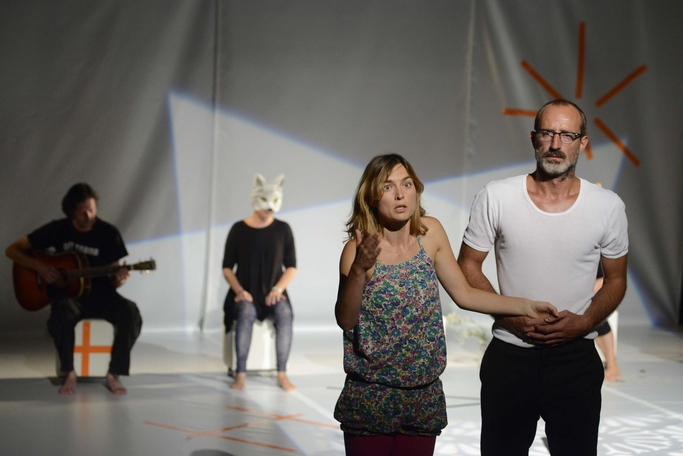
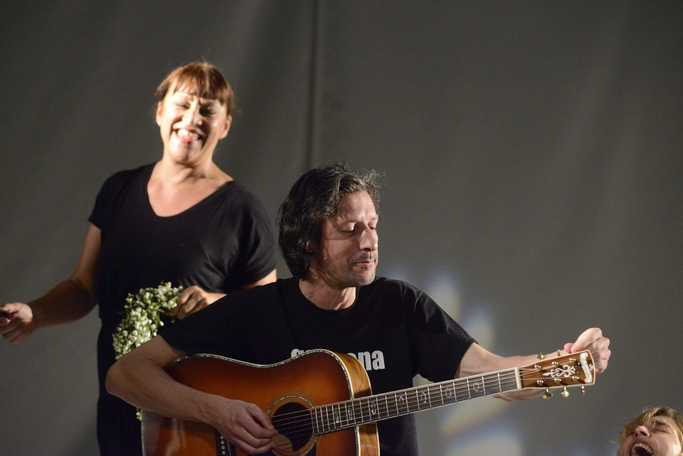
One of the directorial interventions is music, which enters the performance through Vida’s elder brother Luka.
Simona: I found the character of Luka to be one of the weaker points of the play, as he somehow disappears through the text: he’s there, and then he isn’t and he appears again, and he vanishes a little …From the dramaturgical aspect, his role seemed crucial, because he’s the only one who takes her as she is; he even says it in the text, She’s not ill, she is she! And in a way it’s fine that Vida has Dravet syndrome. Then she’s pretty and white and she cuddles so much. She’s something special. Luka is learning how to play the guitar and has a band with his classmates called Hoorrah, Nosferatu! and so I, in the desire to support Luka’s character and have live music in the performance, concluded that it would be the best if Luka were the musician of our performance, Boštjan Narat.
Another prominent element are two poems by Andrej’s daughter Lana that are included in the performance.
Simona: In addition to two experts for epilepsy and neuropsychology, Dr Igor M. Ravnik and Dr Vali Tretnjak Glavič, we also invited Andrej and his wife Klara, and it was then that Andrej told us that Lana writes poetry and prose. He sent them to us and we found them so beautiful, so perfect in contents and form that we all – the entire team – immediately wanted to include them in the performance. And quite instinctively we also found the spots in the performance where they fit very quickly. To me, on a conceptual level, it meant an additional reinforcement of Vida’s character and my desire to present her beauty, her will to live. Yes, if Aleš got his defender in Vida, I thought in this process I had to act as Vida’s advocate.
The play opens a series of questions; from the stigmatisation (of children), the reorganisation of a family and misunderstanding they face from extended family and society, the critique of the healthcare system, etc. … Andrej, did you question “political correctness” in the process of writing? – during rehearsals we discussed a lot about how we didn’t want to present Vida merely as a sick child, and that we wanted to show the Petrač family in harmony with Nataša’s line: “We’re normal, we just need to follow the rules.”
Andrej: We have certainly always perceived our daughter as an ill child – but ill in the sense of a child who needs help, who most likely will never be able to take care of herself. But at the same time we’ve never wanted to give her an impression that there’s anything wrong with her. After all, she didn’t even know about her seizures; if she did know that a moment ago we’d been walking through the park and then suddenly she woke up in a hospital following an epileptic seizure, this was normal to her. We were constantly worried about the moment when she’d finally realise she’s “different” and how painful this would be for her. But this came to the surface very rarely. Because she attends a school for children with special needs who have very different abilities, she takes it for granted that some people can do certain things and some can’t. She kind of accepts that at the age of fourteen she cannot do addition above ten, although her seven-year-old brother can, but what can we do; she’s still dreaming that one day she’ll drive a car and have children, like her mum, and there’s no need to destroy these dreams for her. She’s normal in that she’s happy and sad, loving and loved, that we have fights with her over her behaviour just like we would with any other teenager. To herself, she’s definitely normal like I’m normal to myself.Some people are ashamed of their child’s attacks, or developmental challenges, they lock them up … We often put on a spectacle with our daughter, but my wife and I simply demanded some sort of recognition that these situations are normal. If the president of the country yells at a group of 18-year-olds from some terrace: “Yeah, baby, do this to me,” then it’s a whole lot more normal that we pull down our daughter’s knickers when she seizes in public and administer the medication to stop an epileptic seizure rectally. Actually, this is not a good comparison. The president wasn’t administered medication at all … But anyone has a right to a seizure. Generally, yes: with political correctness you get nowhere in serious life trials: you only retain sense with some healthy self-distance, irony, too. And even then it can happen that a part of the family is on anti-depressants, while another, or both, occasionally try to indulge in a beer, or two, or three … conflicts in the play are partly based on our actual occasional fights in that time, but the ones in the play are far more destructive than ours were, so that they fit into the fundamental conflict, which ,thank god, wasn’t our conflict.
Simona, a riposte?
I totally agree with Andrej that we must speak up about these things! Parents locking up children inside so others don’t witness their seizures is a mediaeval mentality that needs to be shattered in any way and by any means possible, or at least moved to the level of the modern age.
And art is, in a way, the means by which it can be done. I think that as an artist I must constantly be aware of my political function or responsibility.
About the healthcare system: explain the healthcare system of the Republic of Slovenia? I remember that – many, many years ago – there was some sort of a healthcare system. In the beginning of the 1990s, there was an attempt of a healthcare system, but from there, instead of going upwards, it has only gone down. So I think there is no healthcare system. But there is a bureaucratic system, and a very solid one at that.
In addition to all the challenges that his slightly different daily family life poses to him, Aleš, a writer, also faces the challenges of a precarious worker in the field of culture. Andrej, how do you perceive your own position? Do you see a part of your mission in the “awareness-raising” (in the case of Hura, Nosferatu! also about such specific things as Dravet syndrome?)
I wouldn’t call it “awareness raising”, but rather “thinking”. Through this text – and my previous texts – I’ve been thinking about my own reactions to different phenomena, events. I didn’t comment on events – I learnt how to think about them and about myself. To think about what is normality, what compassion, what responsibility and where are the limits of what a human can bear. Dravet syndrome may be a marginal thing, perhaps about ten children have this diagnosis in Slovenia; but fighting a personal disaster, the feeling of guilt, is a universal thing. You can present a series of cruel medical situations that in this society, obsessed with “normality”, glamour, financial success, are completely misunderstood, ignored and redundant – we can call this raising awareness. But a professor I greatly respect said the other day on television how he likes to tell students that they can learn more from a good novel than they can from law and criminology textbooks. I think this is exactly what he wanted to say: that literature can teach you thinking rather than just providing information, like Google does. As far as precarious workers are concerned, this is all connected: apparently, in the last couple of years we finally have a government which considers thinking a cost. They themselves no longer want to think: they hire experts for a couple of hundred thousand Euros to help them prove how right they are. This is a good cost. Culture and education; they won’t finance that – it’s a cost that doesn’t reinforce power. Even more – the very idea that people should think is boring; people have simply become a nuisance. Even the most fucked-up communists have always been at least interested in what authors write, even those most critical ones. Stalin personally telephoned Pasternak to hear what he thought of Mandelstam’s arrest. Although Pasternak wasn’t allowed to publish at all, Stalin made sure he had the means to survive. Today we don’t need this anymore, because the new iPad model with graphics ten times better for the games overrides any thought. Perhaps I should write a play that would be more attractive than Angry Birds and maybe I’ll convince a member of our elite. Not very likely. But if anyone at least delves a little deeper watching it, I’ll be happy. Despite the fact that this text yielded the lowest fee of them all. What can we do, times are such that we pay bankers for thinking rather than living people.
Simona: All I can say is that I’s sign off on everything Andrej has said, if anything, I’d add that things are even worse, really.
Interview by Simona Hamer