Conferences
Adrian-Silvan Ionescu: Elegant pomp and Occidental democracy in the Romanian apparel from the 19th century
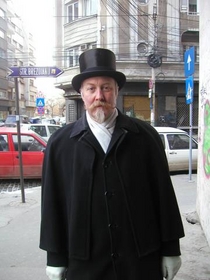
On Sunday, October 23th, starting with 11 a.m., at The Black Box from NTB there will be held the conference entitled: Elegant pomp and Occidental democracy in the Romanian apparel from the 19th century by Adrian-Silvan Ionescu. Tickets can be found at the price of 23 lei or 10 lei.
About Adrian-Silvan Ionescu
Born in 1952, he studied at the Nicolae Tonitza Fine Arts High School and afterwards at the Nicolae Grigorescu Institute of Fine Arts, the History and Art Theory department, which he graduated in 1975. He worked as a museographer at the National Art Museum and then at the Municipal Museum Bucharest where he even was an assistant director (1990 - 1993), afterwards he was a cultural counsel of the Cultural Inspectorate from the Bucharest Municipality (1994 - 1995). He dedicated himself to research and, from 1995 to 2011, he was a scientific researcher I at the Nicolae Iorga History Institute. From the 1st of May 2011 he is director at the George Oprescu Art History Institute. PHD in historical science (1997). In 1996 he started to teach. At present he is an associate professor at the National Arts University, where he holds photography and film history lectures, as well as a master's degree course. He is an art critique and historian with a long activity as a plastic historiographer and exhibition organizer. He published 12 books and edited other four. For his work he was awarded with the Romanian Academy's Prize (1992), The Union of Plastic Artists for Critique ‘s Prize (2002) and the ‘Simion Mehedinţi' (2003), ‘Nicolae Bălcescu' (2008), ‘I.C. Filitti' (2009) and ‘George Oprescu' (2010) prizes from the ‘Historic Shop' Cultural Foundation.
He is knight of the Cultural Merit Order (2004) and of King Mihai I medal for Loyalty (2010).
About the conference
‘The Romanian States, situated at the border between the Occident and the Orient, have been under a strong influence from both sides. They could be felt the strongest at the beginning of the 19th century. The struggle between the status of the fanariot ruler's pompous garbs and the lack of status, the naturalization and the standardization of the ‘democratic garment' - the tailcoat or the black frock coat (also popularly called ‘German clothes') give measure to the major changes from the urban Romanian society.
The conference proposes to describe, in detail, the garb of the high society as well as that of the common people during an entire century, from the modernization to the assimilation in the great European fashion trend.' Adrian-Silvan Ionescu
Translated by: Izabella Feher
MTTLC, Bucharest University