Conferences
Adrian Vasilescu: Religion and the Star
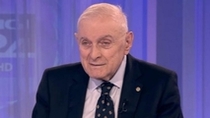
On Sunday, November 26th, 2006, at the NTB Black Box Hall, Adrian Vasilescu held the conference entitled Religion and the Star.
About the conference
Will we join or not the European Union on January 1st, 2007? An obsessive question that concerns the population, businesses, politicians, and government. We are so concerned that we have almost forgotten about the recent incident in the relations with the International Monetary Fund.
Of course, the European Union has also faced us with some performance criteria to which the Romanian economy must comply. But first and foremost, it expects Romania to learn even better how to use its monetary resources efficiently, as many as they are, in order to reduce inflation and stimulate development.
A cardinal problem, in this sense, is the distribution of money resulting from internal savings. Because the state budget has drastically limited their access to this money, so that it becomes more available to the private sector. Since then, the pressure on interest rates has begun to fall and economic development has been better stimulated. One of the reasons why the European Union - doubling the International Monetary Fund - is asking us for a low budget deficit is precisely to increase the chance of supplying money to the private sector. Without having taken this decisive step in the 2000s, we would not have been able to cope in any way with the wave of globalization that is sweeping the world in which we live.
Our European integration is closely linked to the ability to find optimal answers to the challenges of globalization. For us Romanians, this planetary problem is accompanied by many local details, summarized in an essential question: A "How do we want to live and what do we do to get out of the red light of living standards? A question we can not separate, no matter how "sectoral" it is, from nowadays globalism, which has as its religion the GDP growth and as an indisputable star the economic efficiency.
So here are the landmarks: how much GDP we make and what kind of rhythm we set for economic efficiency. Looking into the mirror of a world obsessed with growth and trying to find our answer to the question of how we manage (or fail) to meet the challenges of globalization, we can not omit an essential question: what kind of horse we ride.
We are very aware that we do not feel underneath us a sorrel, to run like lightning, but a modest horse, too little accustomed to the market economy and without speed of reaction. Our race is slowly evolving, and the fear of reform has become a chronic disease. Restructuring production in state companies and large state-owned enterprises is progressing slowly. Monopolistic positions continue to be sacredly guarded. The population is scared of commodity prices and service tariffs, which are rising slowly, but steadily. Consumer price indices have continued this year as well, especially towards the end of it, to give unprofitable businesses the illusion of survival through inflation. State manufacturers are still trying to make their game as usual: to live on high prices, which cover exaggerated costs, reject production, waste and theft, while their supply of goods has remained limited. Paradoxically, the solvent demand has picked up. The main drivers that could set the economy in motion are competition and free markets. However, as these engines were only partially put into operation, the Romanian society continued to consume more than it produced, resulting in serious deficits. They were reflected and are reflected in the budget, but also in the external imbalance.
So if we want to ride the wave of globalization well - to stay in the spirit of this exciting parable - we will need to turn our horse, if not into a thoroughbred, at least into a competitor of average value. How? We have no reason to hope that it could happen as the story goes: to feed him a tray of embers, which would turn him into a proud long-distance runner. Because one tray won't be enough. It takes a lot of embers. In this sense, it would be good if at least now, at the nick of time, when we are only a year, a month and a week away from January 1st, 2007, we would understand that economic efficiency becomes a cardinal need. And that we have to learn to do a lot with little money, not like before when we did a little with a lot of money.
The fact that, since 2000, we have already begun to conquer some of these strongholds, seems unusual to us. And maybe even incredible. We, who have learned to stagnate, find it harder to notice that something is really moving. But that's because the imbalances in the economy still give us headaches. There are enough: extrapolation of waste, mismanagement, fraud and corruption; work motivation continues to fade away; delays in multiplying the incentives that determine the extension of free initiative in production. But one of the most sore points is the average monthly salary in Romania. A salary below the level of prices, well below this level, but also above the level of productivity and efficiency. Here is the key to the problem.
About Adrian Vasilescu
Advisor to the NBR Governor. Born on March 23rd, 1936. Professional certificates in economics, law and journalism. Debut in journalism in 1962, at Scânteia tineretului. Over four decades of journalistic career; commitments to newspapers, magazines, radio and television stations. Until 1996: associate professor at the Academy of Economic Studies and at the Higher School of Journalism. Since 1996: coordinator of the communication strategy at the National Bank of Romania. In 2000, at the Government, a member in the team of advisors to Prime Minister Mugur Isărescu. Since 2001: return to the National Bank, to the advisory team of the NBR governor.
Translated by Simona Nichiteanu