Workshops
The starting point of acting
Radu Penciulescu was Andrei Şerban’s mentor for stage directing, whom he convinced to change sections, from acting to studying the science of theatre, the same as he did with George Banu. In a way I expected their working style to be similar and probably the actors before Şerban expected that, too. I had previously seen many of Penciulescu's exercises, at the Purification rehearsals. The working atmosphere was similar to that from school for some of the former students of Sanda Manu, such as Ioana Calotă, Mihai Calotă, Alex Nedelcu and Maria Obretin. Both Sanda Manu and Penciulescu have a great sense of humour and their teaching examples are jokes most of the time or thousand-year old theatrical stories. Penciulescu is a very good story-teller but without presenting pure anecdotal (...)
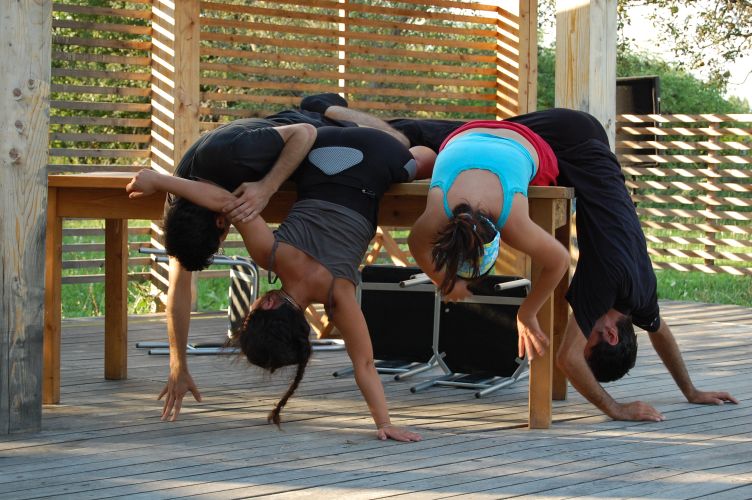
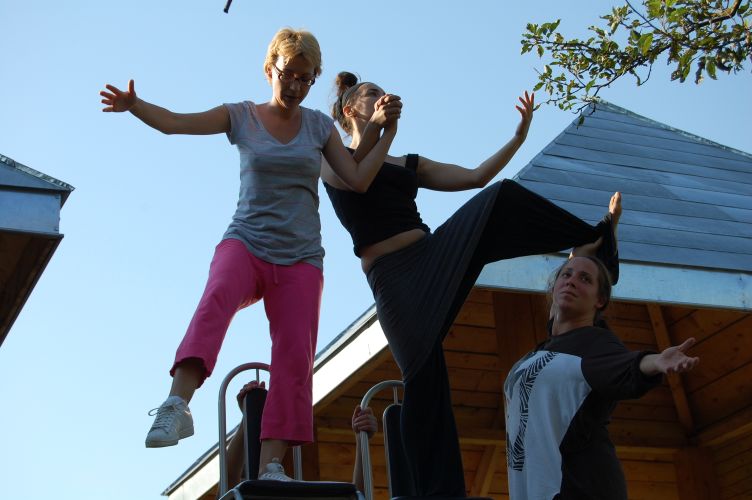
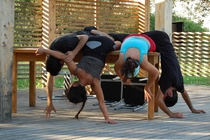
The Ipoteşti workshop comprises three hours and a half of daily practice and actual acting during the last ones, work on texts (Chekhovian plays and Harold Pinter's Celebration). There were multiple rhythm and coordination exercises but also presence, attention or trust ones. The purpose of the first ones is to make the participants aware of their own body, awareness which does not appeal to the intellectual analysis but to the corporal memory (which means working with objects including imaginary ones). The presence and attention exercises are meant to activate the "here and now" reflex, to empty the soul from the useless mental and emotional outside the stage feelings and to connect to the other stage partner; such a best known exercise is the "Mirror": the two partners are facing each other, one is moving and the other one has to mirror his movements, in a blind man's version of the "mirror", the two partners are back to back and each one feels the movements of the other and has to coordinate them. The trust exercises, which are inevitably attention ones too, are complicated till one of the participants allows himself to fall from a higher or lower height (for example, the height of a piano) and the other ones have to catch him. The story behind this exercise is fascinating: in Şerban's ancient trilogy, Priscilla Smith (Andromache from Troy) used to fling herself from the balcony, in the arms of the women from Troy, which received her as a divine gift, creating an image more powerful than any other monologue about the power of survival of Priam's ancestors. (...)
Theatre means absolute simplicity: the truth about staging is the starting point of acting - just like Barthes' history of literature; the history of theatre is one of the types of interpretation (of the actors and of the director). Acting, this theatrical "writing", has become in its turn false evidence meant to hide the absence of reality, pretending to 'express' reality. The actor of today announces his own status in a demonstration of unhidden exhibitionism ('Look at me I am an actor and I am acting life'). Radu Penciulescu's pedagogy fights against this exhibitionism, against the style and for the return to the starting point of acting, humanity in its polyvalent trivial.
The workshop was organised in collaboration with the "Mihai Eminescu" National Study Centre.
Iulia Popovici, Observatorul cultural: THEATRE. The starting point of acting