NTB Conferences
Order
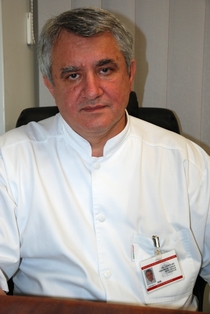
Dr. Vasile Ciubotaru: The Hippocratic Oath and the Current Age
06 May 2020Video-streaming On Sunday, 8th March 2015, at 11.00h, at the Atelier Hall of the National Theatre, Dr. Vasile Ciubotaru will hold the conference entitled The Hippocratic Oath and the Current Age. Ticket price: 16 lei. About the conference: Ever since the old times, people have entrusted other peers with the ailments of their bodies and souls: healers, curers. The relationship between the patient and his healer was regulated by some laws included in the Hippocratic Oath, laws which were kept and carefully observed throughout the time. These resisted in their initial form for milleniums, but in the present-day society they tend to change their meaning through the influencing of the therapeutic directions, under technological, social and economic pressure. Must the patients’ preferences be taken into consideration, as well as the administrative factors, which, in turn, are influenced by the mass-media, by the companies and by the public opinion? Is the contemporary doctor obliged to take into consideration the Hippocratic ideals and adapt them to modern medicine? Does the oath remain only a festive moment at the parting with Alma Mater? Is medicine a professional vocation or does the doctor remain a public clerk? About Doctor Vasile Ciubotaru Born on 19.09.1953, in the Timiș county. Education: 1973-1979 – Faculty of General Medicine and Pediatrics - IMF Iași. Neurosurgical Consultant, first place in the National competition exam in 1993. The Neurosurgery III Section Chief, „Prof. Dr. Bagdasar Arseni” Emergency University Hospital, Bucharest. PhD in Medical Sciences, with the doctoral dissertation paper „Indications and Methods in the Neurosurgical Treatment of Pitulary Gland Tumours”, 1998. Professional training: neurosurgery courses in Romania, Germany, Morocco, France, Turkey. Remarkable professional achievements (in collaboration): - The first endoscopic ventriculocisternostomy in Romania -The first intraoperative detection of evoked potentials in Romania - The introduction of the operating microscope and the endoscopic assistance in the transsphenoidal resection of the pitulary tumours. - The first endoscopic transsphenoidal surgery of a pitulary tumour in Romania. Professional activity (surgeries since 2000): - over 2200 pituraly tumours and skull base tumours - over 5000 cerebral tumours - over 5000 interventions in the vertebro-medullary pathology Publications: Communicated papers – 160 in Romania and abroad Published works – 50 in Romania and abroad 11 books published Member of scientific societies: The International Society of Pitulary Gland Surgery (since 1994) Corresponding member of the French Neurosurgical Society (since 19998) The Romanian Neurosurgical Society (since 1984) Founder member of the Clinical Endocrinology Association in Romania (2005) Individual member of the European Neurosurgical Society (2010) Vicepresident of the Society of Neuro Oncology in Romania Member of the National Geographic Society (since 1995) Community recognition awards: Citizen of honour of theUdești parish, Suceava county, 2004 Citizen of honour of the Suceava Municipality, 2010. Translated by Chira Manuela Cristina MTTLC, University of Bucharest
Dorana Coşoveanu: When the Paintings Were Shot
05 May 2020Video-streaming On Sunday, November 29th, 2009, at 11 o'clock, at the Black Box Hall, we invite you to the conference held by the art historian and critic Dorana Coşoveanu, entitled When the Paintings Were Shot.Art historian and critic, member of the Fine Artists’ Union, Dorana Coşoveanu is a permanent collaborator of several cultural radio and TV shows, initiator of modern fine art exhibitions, in the country and abroad.During the communist period, she had a complicated professional career, full of obstacles due to her father 's status as a political prisoner, Ion Coşoveanu, who spent 17 years in detention.Rejected by several faculties - Philology, Fine Arts, Drama - she finally managed to finish her studies at the Academy of Arts - Department of Art History and Theory (1966) and Fresco Restoration (1967). She then chose the position of museographer-researcher at the RSR Art Museum.From 1966 to December 1989, she was a curator, editor, museographer at the European Art Gallery of this museum. She published studies, catalogs, scientific communications, press articles, monographs, including: The Dutch Landscape in Seventeenth-Century Etching (1975, Meridiane Publishing), French Etching in the Seventeenth Century (1978, Meridiane Publishing), Octav Grigorescu (1985 , Meridiane Publishing), Sever Frenţiu (2000, Meridiane Publishing), Camilian Demetrescu (2000, Official Gazette), Cela Neamţu (2002, Official Gazette), Rodica Lazăr (2006, Humanitas), Iacob Lazăr (2006, Humanitas). The revolution of December '89 is the decisive event that turns the woman of study into a fighter for the defense of heritage, considering that it is not a "greater iniquity than trying to destroy and overthrow the scale of values in the culture of a nation."In January 1990, the illustrious art historian Theodor Enerscu and the Deputy General Director, Dorana Coşoveanu, were appointed General Director of the National Museum of Art. The management of the two, beneficial for the museum, in the most difficult period of restoration and international establishment of the museum, was only four years (until 1994).From 1997 to 2000, Dorana Coşoveanu was a Ministerial Adviser at the Ministry of Culture.In the post-revolutionary years, she was active as a member of the Civic Alliance and a founding member of the Civic Academy Foundation, in which she collaborated on the museographic project of the Memorial to the Victims of Communism and Resistance, in Sighet.In December '89, Dorana Coşoveanu, historian, art critic and museographer of the National Art Museum of Romania, was protecting and storing the most important works of the European Gallery (Rubens, El Greco, Memling, Van Eyck, etc.), before the nightly fire of the building started. Ensuring permanence in the museum, between December 21st-25th, she managed - together with some brave collaborators - to protect and store major works of art, during the "terrorist" deployments in the palace. Patricia Coste, editor at Antene II - Paris, broadcast some of these actions, generating the wave of sympathy and mutual aid of some great western museums. The revolution of December '89 is the decisive event that turns the woman of study into a fighter for the defense of heritage, considering that it is not a "greater iniquity than trying to destroy and overthrow the scale of values in the culture of a nation."In January 1990, the illustrious art historian Theodor Enerscu and the Deputy General Director, Dorana Coşoveanu, were appointed General Director of the National Museum of Art. The management of the two, beneficial for the museum, in the most difficult period of restoration and international establishment of the museum, was only four years (until 1994).From 1997 to 2000, Dorana Coşoveanu was a Ministerial Adviser at the Ministry of Culture.In the post-revolutionary years, she was active as a member of the Civic Alliance and a founding member of the Civic Academy Foundation, in which she collaborated on the museographic project of the Memorial to the Victims of Communism and Resistance, in Sighet.In December '89, Dorana Coşoveanu, historian, art critic and museographer of the National Art Museum of Romania, was protecting and storing the most important works of the European Gallery (Rubens, El Greco, Memling, Van Eyck, etc.), before the nightly fire of the building started. Ensuring permanence in the museum, between December 21st-25th, she managed - together with some brave collaborators - to protect and store major works of art, during the "terrorist" deployments in the palace. Patricia Coste, editor at Antene II - Paris, broadcast some of these actions, generating the wave of sympathy and mutual aid of some great western museums. During the conference, a film made by TVR on January 3rd, 1990 (editor Mihaela Creţulescu) will be screened, which presents the damage caused to works of art. "A day as a human being is better than a thousand days as a shadow," says a Chinese proverb. My revolution - because each of us believes he is the owner of one, strictly personal - made me feel truly human. That is why I cannot forget it and cannot help but love it. It persuaded me, once again, that the spirit is incapable of doing anything without the illusion of freedom. (Dorana Coşoveanu) Translated by Simona Nichiteanu
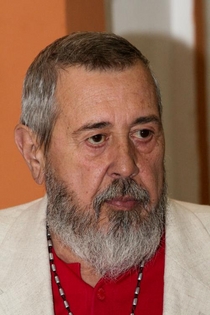
Alexandru Tocilescu: About Theatre and its Matters
04 May 2020Video-streaming On Sunday, March 27th, 2011, at 11.00 at the Black Box Hall, director Alexander Tocilescu presented the conference About Theatre and Its Matters. About the Conference Alexander Tocilescu does not fall short of his constant concern for investigating recent history. After successfully staging plays such as "A Day from the Life of Nicolae Ceausescu", "Elizaveta Bam", "Red Comedy" (within the NTB programme "The Trial of Communism through Theatre"), "Zoica’s House", the well-known director holds at the NTB Conferences a lecture entitled "About Theatre and Its Matters", on the ever-present topic of resistance through culture. ''The topic of the conference would be an attempt to clarify aspects of resistance through culture in the field of theatre: how and if this existed!'', declares the director who enacted in full censorship an extraordinary "Hamlet" in an anti-communist key. Recall that on March 27th, the World Theatre Day is celebrated symbolically - which lends Alexander Tocilescu’s conference a special significance. Translated by Simona Nichiteanu
Alex. Stefanescu: Who needs literature today?
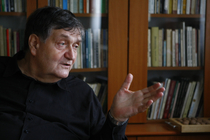
28 April 2020Video-streaming here On Sunday 22nd of March 2015, at 11.00 o'clock, in The Black Box Hall of TNB (The National Theatre of Bucharest), Alex. Ștefănescu will give a conference on the topic Who needs literature today? About the conference "I am often asked: who needs literature today? Here is my answer: we all need literature, but we don't know we need it. Hundreds of years ago, seamen sailing across seas and oceans for a long time got sick with a mysterious disease: they got spots on their face and on their legs, their gums bled, they became hideous. No one knew why. Many years later it was discovered that the disease - called scurvy - was caused by the lack of vitamin C in sailors' food (sailors used to eat, owing to the force of circumstances, biscuits, pastrami, but not fresh fruit and vegetables. We are in a similar situation. We grow uglier and uglier and we do not see why. People who read are beautiful. Of course, reading doesn't change facial features. The design of our physiognomy doesn't change. But the face of a cultivated man irradiates noble-mindedness, it is surrounded by some sort of a halo which is very easily seen." (Alex. Ștefănescu) Despre Alex. Ștefănescu Critic and literary historian, novelist, playwright, journalist, producer of TV shows. Born on 6 November 1947. Editor (since 1990) and chief-editor (during 1995-2010) of the Literary Romania (România Literară) magazine. Author of thousands of articles and of 24 books, among which The History of The Contemporary Romanian Literature was a great success. 1941-2000, published in 2005 (The Union of Writers Award, The Academy Award). The volumes Secret Diary - 2009and Male asleep in his armchair - 2010 went out of print in bookstores and were reprinted by popular demand. A cubic meter of culture Show, broadcasted by Reality TV (Realitatea TV) won him the APTR Award for talk-shows in 2004 and another show, made for TVR Cultural, The History of The Contemporary Romanian Literature retold by Alex. ȘtefĂnescu - won him The APTR Award for cultural programs in 2008. In 2009 he published a book about two hundred and fifty bad books, How you can fail as a writer. Also in 2009 he began to make The Pearly Hood, a TV show on the same topic. Between 2011-2013, this was followed by The Public Lighting Show, dedicated to valuable books published after 1989. Alex. Ștefănescu's latest books are Texts That Used To Nothing, A Writer, Two Writers and Message To the Youth. Rediscover Literature !, all published in 2014. At the end of the conference, the writer will give autographs on his latest book, Message To the Youth. Rediscover Literature! Bucharest, Curtea Veche Publishing House, 2014 (second edition - 2015). Volume price - 20 lei . Photo credit : Eduard Enea Translated by Aureliana Grama MTTLC, University of Bucharest

Silvia Colfescu sharing stories with Anamaria Smigelschi
26 April 2020Video-streaming On Sunday, December 8th, 2019, from 11.00 am, the NTB Black Box Hall will host the conference Silvia Colfescu sharing stories with Anamaria Smigelschi: About the Romanian Bohemia of the ‘70s-‘80s. Reunion with the art of Ion Alin Gheorghiu and Vladimir Setran. About the conference After a first conference held at NTB in 2018, entitled Stories from Bucharest - a City with the Calling of Survival, writer and graphic artist Silvia Colfescu returns with a new conference, this time in the form of a dialogue with graphic artist Anamaria Smigelschi. You are invited to a discussion about the fascinating bohemia of the '70s-'80s, but also to a reunion with the fine art of Ion Alin Gheorghiu and Vladimir Setran, some of their paintings being permanently on display in the lobby of the Black Box Hall. Silvia Colfescu is a graduate of the Faculty of Art History of the Institute of Fine Arts "Nicolae Grigorescu" (currently the National University of Arts). Co-founder of the Bucharest Weather magazine, she is a translator from French and English, illustrator, writer. Selective bibliography: 1982 - A Happy Family, Ion Creanga Publishing, Bucharest, republished in 1990, Vremea Publishing, Bucharest; 1985 - Dictionary of Romanian Language for Students, fine arts department, Didactic and Pedagogical Publishing House, republished in 1999 at Cartier Publishing, Bucharest; 2000 - Bucharest, historical, tourist, artistic guide, Vremea Publishing, Bucharest, republished in 12 updated editions; 2004 - Two months in Europe, Vremea Publishing, Bucharest; 2009 - Cats of Bucharest, Vremea Publishing, Buc .; 2013 - Fabulous Aunts and other Stories from Bucharest, Vremea Publishing, Bucharest. Anamaria Smigelschi is the daughter of architect Victor Smigelschi, son of the Transylvanian painter of Polish origin Octavian Smigelschi, and Maria Anna Giuseppina Trinchieri, of Italian origin. She was married to painter Ion Alin Gheorghiu, who died in 2001. Fine artist - graphic artist, Anamaria Smigelschi has been distinguished throughout her career with numerous national and international awards; she created easel graphics, engraving, graphic design for illustrated magazines, television shows, advertising and poster graphics, book graphics. She is the author of eight children's books and has illustrated countless others. She has published at the Humanitas Publishing House the volumes of memoirs "Taste, Smell and Memory" (2013), "From Yore, from Afar" (2015) and at the Vremea Publishing House "Passersby Passersby" (2019). Translated by Simona Nichiteanu

Ioan Stanomir: Romania, 1989 / 2019 - a Photograph, after Thirty Years
20 April 2020Video-streaming On Sunday, May 5th, 2019, from 11.00 a.m., Ioan Stanomir shall hold the conference entitled Romania, 1989 / 2019 - a Photograph, after Thirty Years. About the ConferenceWhere are we, three decades after 1989? What are the factors that shaped contemporary Romania? What is the place of this interval during the 19th century since 1918? These are the questions from which the present conference departs. It does not intend to give definitive answers, but only to encourage the exercise of patriotic lucidity. Without the latter, our homeland cannot build a future based on freedom and human dignity. Ioan Stanomir About Ioan StanomirIoan Stanomir is a professor at the Faculty of Political Science at the University of Bucharest. The published volumes include Conservative Consciousness: Preliminaries to an Intellectual Profile (2004), A Vanished World: Four Personal Histories Followed by a Dialogue with H.-R. Patapievici (co-author, together with Paul Cernat, Angelo Mitchievici and Ion Manolescu, 2004), Explorations in Romanian Communism (coauthor, Paul Cernat, Angelo Mitchievici and Ion Manolescu, vol. , Conservative Spirit: From Barbu Catargiu to Nicolae Iorga (2008), OnSounds and Memory: Fragments of the History of Ideas (2009), The Defense of Freedom (1938-1947) (2010), Teodoreanu Reloaded (with Angelo Mitchievici, Shadows on the Canvas of Time: Sequences of Intellectual History (Humanitas, 2011), Junimism and the Passion of Moderation (Humanitas, 2013), The Russian Sphynx: Ideas, Identities and Obsessions (2015), Communism inc. (alongside Angelo Mitchievici, Humanitas, 2016), Russia, 1917: The Bleeding Sun. Autocracy, Revolution and Authoritarianism (Humanitas, 2017), essay Shadow of Russia in the collective volume The Russians Are Coming! 5 Perspectives on a Dangerous Neighborhood (Humanitas, 2018), At the Centenary. Rereading the Century of Great Romania (Humanitas, 2018). Translated by Simona Nichiteanu

Andrei Oisteanu: Jews of Romania in a European context: similarities and differences
16 April 2020Video-streaming On Sunday, April 7th, 2019, at 11.00 at the NTB Small Hall TNB, Andrei Oisteanu shall hold the conference on the Jews of Romania in a European context: similarities and differences. About the Conference The history of the Jews in Romania is less well known in the world. Other Jewish communities in Eastern Europe (Russia, Poland and even Hungary) were more vocal and more visible. I am trying to colour this stain, if not white, at least gray. Especially because it was a large and important community. In 1939, the Great Romanian Jews counted about a million souls, being the third community in Europe and the fourth largest in the world, after Poland, the Soviet Union, and the USA. A quasi-heterogeneous, but unitary community with a special contribution to Romania's political, economic and cultural history. One third of them died in the Holocaust, others fled from communism. The fundamental event that marked the difference between the Jews in Romania and those in Europe was the failure to grant Romanian-Jewish citizenship with the adoption of the "liberal" Constitution of 1866. Romania missed the synchronization with Europe, a fact with major socio-political-cultural consequences: the emergence of economic antisemitism (in addition to the racial and religious one); the strengthening of their own community institutions; the premature emergence of the Zionist movement in the Romanian space, etc. The Jews in Romania are different because (and to the extent that) Romania is different. Andrei Oisteanu About Andrei Oisteanu Andrei Oisteanu is an anthropologist, historian of religions and mentalities, being a member of the Scientific Council of the Institute of Religious History (Romanian Academy). He is associate professor at the Hebrew Studies Center (Bucharest University). He is a member of the Social Dialogue Group. In recent years he published the following books at the Polirom Publishing House: The Image of the Jew in Romanian Culture (2012), a book translated into English, German, French, Hungarian and Italian (several awards in Romania, Italy, Belgium, Israel, , B'nai B'rith Europe Award, Writers Union Award - Bucharest Association); The Garden of the World Beyond (2012); The Box with Old People (2012); Order and Chaos. Myth and Magic in Traditional Romanian Culture (2013), translated into English and Italian; Religion, Politics and Myth. Texts about Mircea Eliade and IP Culianu (2014); Narcotics in Romanian Culture (2014), translated into German (Special Prize of the Writers’ Union); Sexuality and Society. History, Religion and Literature (2016, 2018), English translation (The Writers of the Year 2016 Award). Andrei Oisteanu was awarded by the Romanian President the Order of the Star of Romania (2006) and by the Italian President the Order of Stella della Solidarietà Italiana (2005). Translated by Simona Nichiteanu

Toni Grecu: Let Us Be Joyful Lest We Are Sad
15 April 2020Video-streaming On Sunday, February 24th, 2019, from 11.00 at the NTB Small Hall, Toni Grecu shall hold the conference with the topic Let Us Be Joyful Lest We Are Sad. About Toni Grecu Born in 1959 in Iasi, Toni Grecu attended the Electronics and Telecommunications Faculty of Iasi, performing shows either individually or in various formulas in the student literary circles. At the same time, he launches together with other colleagues the Divertis Group. The engineering career is short, intense and insignificant, but helps him reach Bucharest, where, immediately after the Revolution, he gives up computers and devotes himself exclusively to artistic activity, both on stage and on television. In the eighties, Divertis goes on several tours around the country at student events such as the Amphitheater Galas, the Moldavia Literary Circle, the Sea or the Snow Celebrations. In 1983, he won the first prize at the National Student Humour Festival, both individually, at the monologue section and with Divertis. In 1988, alongside Doru Antonesi, he writes the text for the one-man show "I am Staying Home Tonight", staged by Silviu Purcarete and starring master Stefan Iordache at the Small Theater. It was an appreciated performance, unique in its way primarily for the courage and harshness of satire on topical subjects. The representation, which was sold out, seemed to predict the end of the communist regime. Since 1990, he has been working with Divertis on television, first on TVR and then on Pro TV and Antena 1 as a presenter and screenwriter. Along with Divertis, he has performed over 1,000 shows and hundreds of TV shows, achieving true audience records. He retires from Divertis in 2008 and continues the series of TV shows in a new formula with the project "Romanian Comedy Service" at Pro TV for another five years. He then creates the news comedy show "Superjournal" at Digi24 for two seasons in 2015. Meanwhile, he and Adrian Onciu write together the script of the comedy The Bride Was Stolen in 2012 and produce the sitcom Dementia Hospital in 2012-2013 also for Pro TV. Following the general trend, in 2016, he began working as a screenwriter and developer of comedy projects for the online environment that gathers millions of views. He resumes the stage activity and, together with Catalina Grama - Jojo, Catalin Neamtu, Claudiu Maier and Cosmin Natanticu, he creates the humour show One day in my life, a mix of comedy of several genres, monologue, impro, sketch, stand-up , parody, imitation, which shall soon be resumed in a new season. Toni Grecu, who in 2010 received the UNITER Award for Entertainment, "for His contribution to the living history of Romanian humour," shall hold a conference on humour, schadenfreude and pool cormorants at the Bucharest National Theatre. Translated by Simona Nichiteanu

Ana Blandiana: The Centennial, an Exercise of Exorcism
13 April 2020Difuzare online On Sunday, December 2nd, 2018, from 11.00 a.m., in the NTB Painting Hall, Ana Blandiana shall hold the conference entitled The Centennial, an Exercise of Exorcism. About the Conference We are the descendants of everything that happened in this last century, starting with the miraculous effort which gave meaning to the previous millennia. We are the descendants of Romanians who accomplished Great Romania and we are the descendants of Romanians who imprisoned and buried these in the Sighet Cemetery of the Poor. The Centennial is not a celebration, it is the occasion forcing us and giving us the chance to opt for whom we want to pursue, to whom we want to further resemble, which are the role models we wish to follow. But this implies first of all the knowledge of the content of the 100 years and accepting the history they comprise. Ana Blandiana About Ana Blandiana Originating from Timişoara, Ana Blandiana was born in 1942. Her name at birth was Otilia Valeria Coman, and after the marriage to writer Romulus Rusan it became Otilia Valeria Rusan. The close ones call her Doina, but the "nickname" which brought her fame is the pseudonym Ana Blandiana. (The poet composed it by taking over the melodic name of the village - Blandiana, from Alba County – where her mother was born and deriving a first name from it as well.) After attending the courses of the Faculty of Philology of the Cluj University (1962-1967), Ana Blandiana settles down in Bucharest, where she works as an editor at the Student Life and Amphitheatre (1968-1974), librarian at the "N. Grigorescu" Institute of Bucharest (1975-1977), editor at the Writers’ Guild (1977-1979). Before even being a student, she celebrates her debut with the poem Originality in the Tribune magazine of Cluj (1959). From 1960-1963, she is forbidden to publish, due to political reasons. Starting with 1964, her signature may be encountered again in the literary press, especially in The Contemporary, where she is entrusted with a weekly column of notations (Antijournal). Still in 1964, she publishes her first book of verse, First Person Plural, drawing the attention of the literary critics. Thus, when she settles in Bucharest, she is no longer a stranger. In 1969, she receives moreover the Poetry Prize of the Writers’ Guild (the first from a long list of prizes: the Poetry Prize of the Romanian Academy, 1970, Bucharest, the Prose Award of the Writers’ Guild of Bucharest, the International Herder Prize, Vienna, 1982, the "Opera omnia" Prize, 1994, the National Poetry Prize, 1997, the Poetry Prize of the Writers’ Guild, 2000 etc.). The poetry books published every two-three years (which are translated abroad), the countless literary criticism articles dedicated to her, the publishing activity (her column Atlas from Literary Romania becomes a weekly event), the journeys abroad (starting with the 6-month scholarship to the USA in 1973-1974), the certainty with which she makes her prose debut (The Four Seasons, 1977) confer to Ana Blandiana an unusual prestige. Disobedient as a responsible character, not as a recalcitrant one, Ana Blandiana reads at her encounters with the audience at the height of Ceauşescu’s dictatorship poems-manifestos thrilling the audience: "It shall come,/ It cannot be otherwise,/ It shall come/ That day/ Adjourned for centuries,/ It shall come/ It draws near,/ It can also be heard/ Its pulse beating/ Between the horizons,/ It shall come,/ It can be felt in the air,/ it can no longer be late,/ Do not doubt, it shall come/ That day/ Blinding as a sword/ Vibrating in the light." (Dies ille, dies irae). In 1985, a series of her poems charged with political dynamite, published in the Amphitheatre magazine, alarms the authorities. And in 1988, after she publishes the verse volume Occurrences on My Street, with numerous sarcastic references to the regime, she is forbidden, as a punishment, to publish in Romania. The wave of the revolution from December 1989 brings her to the heterogeneous leading team of the country, the National Council of the National Salvation Front. Earlier than other intellectuals, Ana Blandiana leaves the group. She sets up and leads the Civic Alliance Foundation, to which a great part of the Romanian civil society adheres, creates in Sighet, with superhuman efforts and sacrifices, joined by her husband, Romulus Rusan, the Memorial of the Victims of Communism and of the Resistance, and leads the Romanian PEN Club. She plays a key role in imposing politician Emil Constantinescu as Romanian President in the time frame 1996-2000, but she does not refrain from criticising his lack of firmness in promoting democratic values. Biography by Alex Ștefănescu Translated by Simona Nichiteanu

Prof. Dr. Dumitru Bortun: Romania - an enigma, a miracle and a paradox. Tasks for the next generation!
05 April 2020Video-streaming On Sunday, November 18th, 2018, 11.00 a.m., in the NTB Small Hall, Prof. Dr. Dumitru Bortun shall hold a conference on Romania - an enigma, a miracle and a paradox. Tasks for the next generation! About the Conference After 1989, a single generalized consensus emerged in Romania that can be considered a public interest: Romania's integration into the Euro-Atlantic structures. In 2018, precisely in the year of the Centenary, some political figures began to express their dissatisfaction with the insistence whereby the European Union is asking us to observe the standards that we are committed to observing. But integration into the European Union is only a means; the goal is to complete Romania's modernization process - a process that began in the nineteenth century. We have no place in the European Union with horse-drawing peasants, growing their geese on the roadside, with employees skipping work and stealing from factories, physicians and teachers accepting bribe, pupils and students copying at the exams, with ungrammatical and irresponsible journalists, with corrupt policemen and magistrates, civil servants opaque to citizens' needs, apolitical citizens, civic conscience, and cynical, amoral and stateless politicians. Under the current circumstances, joining the European Union has proved to be a boomerang: in the post-accession period, we witnessed tensions, contradictions and conflicts - in short, a conflictual integration that could generate an anti-Western reaction, rejection of the values of the European Union and integration into the European Union. Romania is not just "an enigma and a miracle", as George Bratianu wrote. I dare say that it is also a great paradox. Before leaving Romania, the former head of the European Union Delegation in Bucharest, Jonathan Scheele, made a statement as a sentence: "Romania is a country that the more you know, the least you understand it." Regarding lucidity, Romania appears to be a country full of unsurpassable contradictions, moral dilemmas, ideological conflicts, fractures between large groups of society. At first sight, their causes are economic; in my view, they are cultural, they are based on the ideals, values and norms that govern our life. To understand the concept of modernity, the first step is to identify the "values of modernity" that I shall present for the clarity of exposure, in contrast to pre-modern values. Romania's cultural resetting is one of the tasks of the next generation. As Karl Popper said, each generation can give meaning to history by formulating its own purposes. The choice of goals can not be dictated neither by nature nor by an alleged "sense of history"; it can be done by ourselves as responsible beings. In this sense, I shall make some suggestions for the next generation of Romanian citizens. Univ. Prof. PhD. Dumitru Bortun, National School of Political and Administrative Studies About Univ. Prof. Dumitru Bortun Dumitru Borţun holds a PhD of philosophy and is a professor at the Faculty of Communication and Public Relations of the National School of Political and Administrative Studies in Bucharest - SNSPA, where he teaches the courses "Public Speech Analysis", "Semiotics. Theories of Language ", "Ethics in Communication" and "Corporate Social Responsibility". At the SNSPA Faculty of Management, he teaches the course "Business Ethics and Corporate Social Responsibility". In 2009, the National Alliance of Student Organizations in Romania - ANSOC awarded him the title of Bologna Professor, granted to teachers who "are appreciated by the students, add value to education in Romania and are role models for students". In 2015, he was awarded the "Personality of the Year 2015" by Legal Point Magazine for "promoting moral values in communication techniques," and in 2017 the Excellence Diploma for "Integrity, Good Governance and Social Responsibility" awarded by Eurolink - the European House. He has published over 130 studies, essays, articles and interviews in collective volumes, specialized publications, and culture magazines. He is the author of several university courses and the books Epistemic Fundamentals of Communication (Ars Docendi, 2002), Public Relations and the New Society (Triton 2005, 2012), Corporate Social Responsibility: from Public Relations to Sustainable Development, coordinator (Triton , 2012), Epistemic Fundamentals of Communication - Second Edition, Revised and Added (Tritonic, 2013), The Black Tide: Romanian Language Under Siege. Errors of Wording in Romanian Media (Tritonic, 2015), Misprints, Meanings & co. The interdisciplinarity of communication, semiotics and multimodality, ed. (Springer International Publishing AG, 2018). He is a member of the editorial board of several specialized publications, as well as in the scientific committee of international conferences. Since 2016, he is the chairman of the Organizing Committee of the International Conference on Semiosis in Communication, organized once every two years by SNSPA, in collaboration with the International Association for Semiotic Studies (IASS). He is a founding member of the Romanian Association of Public Relations - ARRP (since 1995). The General Assembly of March 2nd, 2005 elected him ARRP President, position he held until May 2008. He is currently the President of the ARRP Jury of Honour. Translated by Simona Nichiteanu