News
Press release, March 27, 2025

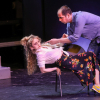
Following the public complaints posted on social networks regarding the performance of "Prophet Ilya", staged by director Botond Nagy on a text by Tadeusz Słobodzianek, the "I.L. Caragiale" National Theatre in Bucharest makes the following clarifications:
The show "Prophet Ilya" does not aim to offend the Christian faith or any other religious belief. On the contrary, it is a reflection on faith, the fragility of human convictions and the dangers of extremism of any kind. It is an artistic approach that encourages tolerance, dialog and a deeper understanding of the complexity of the human spirit.
In addition, we mention that some images that have appeared on social platforms have been taken out of the real context of the performance, presenting isolated fragments in a way that distorts the artistic message of the staging. The performance is not blasphemous and does not aim to ridicule faith, but, on the contrary, it invites a deep reflection on the relationship between man and divinity, on how faith can be influenced or hijacked.
As stated on the performance's official website, "Prophet Ilya" is an invitation to a sincere meditation on faith and religion at a time of deep spiritual and moral crisis. Director Botond Nagy said before the premiere: "My wish is that through this artistic project the audience will look at their own beliefs in a new light and understand the true value of this miraculous inter-human connection that is faith."
The play written by Tadeusz Słobodzianek has already been staged in Romania by the renowned director László Bocsárdi, at the Tamási Áron Theater in Sfantu Gheorghe, with premieres in 2001 and a revival in 2010. Also in 2010, another production of this text was staged at the Municipal Theatre in Baia Mare. These productions contributed to the exploration and deeper understanding of the text in the Romanian theatrical context.
The "I.L. Caragiale" National Theater in Bucharest reaffirms that the performance has no intention of blasphemy or disrespect for religious values. We believe that some critical reactions are the result of a misinterpretation of the artistic message, which does not deny, but on the contrary, highlights the complexity of the relationship between man, faith and society.
We respect each spectator's right to hold his or her own beliefs and encourage open dialog, in the spirit of the values of theater as a place of reflection and freedom of expression. Theater is, by definition, a place of questions, not of imposed answers, a space where each spectator is free to interpret and reflect.
Translated by Andreea Codrea-Boeriu