News
The National Theater will be lit up for European Fertility Week
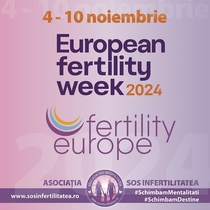
From November 4 to 10, 2024, the 9th edition of the European Fertility Week is taking place, during which Fertility Europe - the pan-European organization that brings together 33 associations of patients affected by infertility from 28 countries - is intensifying its awareness & advocacy actions for the cause of those who want children but can only have them with medical help. On this occasion, the SOS Infertility Association is organizing the 13th edition of the National Week of Awareness of the Medical and Social Phenomenon of Infertility, an event that has been organized in Romania since 2012 and which since 2016 has been held under the umbrella of European Fertility Week.
Among the actions of the Awareness Week organized by SOS Infertility Association we recall:
- Press conference (Monday, November 4, from 11:00, Grand Hotel Continental) - among other topics, on the need to adopt a National Plan to fight Infertility, a proposal that SOS Infertility Association will address to the new government in January 2025.
- Launch of the study The Sociology of Infertility and Demographic Rearmament: a Romanian perspective on the profitability for the state budget of public investment in the conception of a child through in vitro fertilization, author lect. univ. dr. Bogdan Bucur, sociologist.
- Architectural illumination, celebrating European Fertility Week 2024 - supporting the cause of the fight against infertility
Bucharest
• Victoria Palace – Romanian Government Headquarters
• Parliament Palace - seat of the Romanian Parliament
• Special Telecommunications Tower of the Special Telecommunications Service (STS)
• National Opera in Bucharest
• Grigore Antipa Museum of Natural History
• CEC Bank Palace – Calea Victoriei
• Bucharest National Theater
Brasov
• Brasov City Hall
• The letters "BRASOV" on the Tampa
Cluj-Napoca
- "Iuliu Hatieganu" Faculty of Medicine Cluj-Napoca
Sibiu
• Sibiu City Hall
Timisoara
• National Opera in Timisoara
• National Art Museum in Timisoara
- Continuation of the # education_on_fertility campaign: online information about fertility - aimed at the general public, who in principle are not currently experiencing infertility, but could be in this category in the absence of correct information.
- Numerous online collective actions, which are intensely shared by a large number of the 43,000 members of the SOS Infertility FB group.
- After the European Fertility Week, the 8th issue of "What do you know about your fertility?", a fertility education tool produced and distributed free of charge by SOS Infertility Association, will be out of print.
At the European level, during this edition of the European Fertility Week, Fertility Europe is launching the "Gamete Story" campaign, with a focus on human reproduction procedures with third party donors. Fertility Europe, an organization of which SOS Infertility Association is a member since 2010, is calling on decision-makers at European political level and at Member State level:
- acknowledge the right to try to have a child as a universal right throughout the European Union;
- ensure equal, fair and safe access to infertility treatment;
- ensure public funding for all stages of infertility treatment;
- involve the public sector in providing better information about fertility and infertility;
- implement communication campaigns to remove the stigma associated with infertility problems
Messages of #education_on_fertility that the SOS Infertility Association would like to convey to the general public on the occasion of European Fertility Week:
- Infertility affects one in six (or, according to more recent statistics, one in five) couples worldwide.
- Female fertility declines earlier than commonly thought, with oocytes losing their reproductive capacity particularly after the age of 35.
- In half of cases of couple infertility, the male factor is responsible.
- If you want children, don't postpone pregnancy.
- If pregnancy is delayed, see an infertility specialist (not your gynecologist).
- Each year, the number of people going to infertility treatment centers increases by 8-9%.
- In vitro fertilization is an exceptional medical advance that can help infertile couples have children, but it is not a panacea. In vitro fertilization cannot overcome the female age factor.
- No, babies don't come after 40, as we see on the glossy covers of some magazines. Or: they don't come easily. More often than not, those 40+ moms needed egg donation.
- Worldwide, there are more than 12 million people conceived through in vitro fertilization. Currently, a baby conceived through IVF is born every 35 seconds.
Translated by Andreea Codrea-Boeriu