News
Order

Apolodor, A Travelling Penguin
01 February 2015Famous from the story ”Apolodor, A Travelling Penguin” by Gellu Naum (Ion Creangă Publishing House, 1988), a volume charmingly illustrated by N. Nobilescu, but especially from his fulminatory success at Ada Milea’s concerts and her song Apolodor, here we have again this little tenor, sick with longing, who starts out on a new journey from the circus where he ended up, on the ice of a freezer. The Story Magician invites children, but also parents and grandparents, Sunday morning, at 11 o’clock, at the Media Hall at NTB, to a new premiere of the National Theatre for Children. Together they will revive the delightful character and his terrible misadventures while travelling round the world with his unconsumed longing. Translated by: Bianca-Lidia Zbarcea MTTLC, University of Bucharest
20 Years in Siberia, a Moving Dramatic Monologue about the Ordeal of Deportation
23 January 2015With two preview performances on 22nd and 23rd January and the official premiere on 7th February 2015, the „I. L. Caragiale” National Theatre of Bucharest presents Amalia Ciolan in the dramatic monologue 20 Years in Siberia, staged by Sorin Misirianțu after Aniței Nandriș-Cudla’s book „20 Years in Siberia. Memories of Life”. Sorin Misirianțu is a well-known representative of the young generation of show-makers, with numberless mise en scene around the country, especially at the National Theatre in Cluj-Napoca and at the National Theatre in Târgu-Mureș, an actor, a script writer and a film director. He is also the director and script writer of this production within the NTB Programme „The Trial of Communism through Theatre”. „20 Years in Siberia” is a show about the destiny of a peasant woman from Bucovina, who was the author of one of the most important testimonials about the ordeal from the Soviet Gulag. Aniţa and her entire family were also among the 13.000 Romanians from the north of Bucovina, who lived the terror of deportation in June 1941. She lived through the regime of famishment, disease and hard work in a very harsh environment, managing to bring up her sons and return to her native land together with them in 1961. Her memoir book was printed only after 1989, in Romania, at the Humanitas publishing house and was awarded the „Lucian Blaga” Prize of the Romania Academy. It was translated in various languages of International circulation. „After such a book, any inferiority complex we have as a nation should disappear”, Monica Lovinescu assessed. Brought on stage at the NTB, the story gives shape to a show which rouses the benumbed consciences and unveils the terror of communism. It is an invitation to discover the true magnitude of this rod of the twentieth century, upon which today many project a sweetened and nostalgic vision. In the dramatic interpretation of Amalia Cioran we will discover a simple peasant woman, endowed with a writing fluency and a spontaneous way of telling a story, which makes the talent of many renowned artists fade. Without being heavy-laden with hate or imprecations and without ever pronouncing the word „communism”, Anița/Amalia attunes her thoughts and experiences to an exceptional artistic performance, which reveals „the decidedly aristocratic stature of the Romanian peasant”, as Ștefan J. Fay said. For Amalia Ciolan, actress at the National Theatre of Bucharest since 1994, this stirring monologue is at the same time a rediscovery of her acting valences. You could also see her act in other heavily dramatic creations, such as „The Fourth Sister” by Janusz Glowacki, Three Sisters by A.P. Chekhov, „The History of Communism as told to the Mentally Ill” by Matei Vişniec, „The Love Suicides” by Chikamatsu Monzaemon, „Stories from the Forbidden Zone” after Svetlana Alexievici, „Tamburlaine the Great” by Christopher Marlowe, or Macbeth by William Shakespeare, during which she was allotted the role of assistant of the director Radu Penciulescu. The first meetings with the public will take place on: 23rd, 24th, 29th and 30th January 2015, starting at 20.00, at the Media Hall of the National Theatre of Bucharest, and the official premiere will be on Saturday, 7th February 2015. Translated by Chira Manuela Cristina MTTLC, University of Bucharest
Premiere Extended Love
18 January 2015The new premiere of the NTB’s 9G program (The New Generation at the National Theatre), “Extended Love” by Lukas Bärfuss, directed by Elena Morar, approaches themes that aren’t foreign to any of us: the couple in love, boredom, the need for sexual or … existential diversity. The stories of two couples intertwine, passion languishes in a deceptive search for the spices that make life more interesting or more hollow. The psychological analysis of this type of behavior has become a successful business of our time, as the lives of these characters make out a case for Freud’s theories. What matters most in love? Trust, safety, dependency? Or faithfulness? And when they are gone, what is the next step for the mentally unstable wife or for the determined one, a painter dedicated to her work? When life becomes a great big lie, is murder the solution? In a world where people are shocked by their own reactions, or by the reactions of others around them, “Extended Love” doesn’t give answers; instead it burdens us with questions. The play premieres Sunday, January 18th, at 20:00, at the Small Hall of the National Theatre. Translated by Ana – Maria Albu MTTLC, The University of Bucharest
Premiere Allegro, ma non troppo
16 January 2015Friday, on the 16th of January and Sunday, the 18th of January, 2015, the official premiere of the play Allegro, ma non troppo, written by Ion Minulescu and directed by Răzvan Popa, will take place at the Painting Hall of the National Theatre of Bucharest. It is an emotional comedy, full of love entanglements and dramatic cliff-hangers. A satire of manners with a millionaire, a wife and a playwright, but also other picturesque characters – a mistress, a bargain maker, a servant – will captivate you, for an hour and a half, with the charm and savour of the inter-war period. We will witness unexpected appearances and turnabouts, a creative blend of theatre and reality, and adultery committed before the husband’s very eyes, disguised as a fictional play. In the end, it is a plea for the naturalness in theatre, which must draw from life. As a renowned playwright whose plays were so successful in his time, the manager of the National Theatre of Bucharest in 1926, Ion Minulescu (1881-1944) is best known today as the poet of the Novelettes. Although while he was alive the writer believed that posterity would remember him mainly for his plays, he was however dealt another hand by the history of literature. His plays deserve to be rediscovered even today, after decades from their first enactments, for their lively dialogues, the quick wit, the simplicity of the plot, the intellectual verve and the originality of the writing. Some of his most popular plays are: “The Sentimental Mannequin”, “The Storks are Leaving”, “The anonymous lover” and “Allegro, ma non troppo” a comedy that was also performed in Bratislava and Buenos Aires. The audience will have the great opportunity to get to know Minulescu’s characters and situations through the talent of the well-known actors of the cast: Gavril Pătru, Marius Rizea, Eugen Cristea, Costina Ciuciulică, Aylin Cadîr, Victoria Dicu and Răzvan Popa, as the director (he received the UNITER Prize in 2011, for directing the best radio drama, “Shylock”, by Gareth Armstrong). Florilena Popescu-Fărcășanu and Maxim Corciova set up the decor. The premiere ushers the New Year 2015 into the National Theatre ”I. L. Caragiale” of Bucharest. Translated by: Bianca-Lidia Zbarcea MTTLC, University of Bucharest
Premieres and other events at National Theatre in Bucharest in 2015
13 January 2015The I. L. Caragiale National Theatre of Bucharest will include - besides its 35 plays from the current repertoire - new, present-day plays and timeless stories read in contemporary register, plays by some of the greatest playwrights, staged by major directors, valuable encounters with Romanian drama, as well as signature shows. Theatre and paratheatrical events will round off the list of projects and performances scheduled for the beginning of the season. The most important event among all is, without doubt, the 2015 NETA International Theatre Festival, which will be hosted under the roof of the newly-reconfigurated NTB building, between August 28 and September 6, 2015, under the title: Face to face with the Balkans: Theatre – our present-day hero. The first major event to be expected is the opening performance which will inaugurate The Great Hall - NTB's largest hall, comprising a remarkable stage with multilateral settings - once it has been fully refashioned under the extensive rehabilitation works carried out at the NTB. Thus, one of the most cherished Romanian folk-tales, “Get strung, Pearl”, by Victor Eftimiu, will be reinterpreted in a new, modern understanding brought forward by Dan Puric. The next premiere at the Great Hall will mark a new encounter with Shakespeare and his “A Midsummer Night's Dream”, staged by director Petrică Ionescu in a manner especially conceived to emphasize the special capabilities of the stage. Present for the first time at the Studio Hall, another hall with distinctive acoustics and auditorium, director Alexandru Dabija returns to the NTB stage with the play “Requiem”, by a well-known Romanian playwright, Matei Vișniec, a show bound to reveal the playwright's poetic vision of life and death. At the Painting Hall, one of the most praised halls present in the theatre blueprint, young director Bobi Pricop will produce “A Curious lncident”, by Mark Haddon and Simon Stevens. Mark Haddon's award-winning novel, “The Curious Incident of the Dog in the Night-Time”, has been adapted for the stage by Simon Stephens in an emotional play. The performance is expected to come out in the second part of the season. Also, new performances will be added to the current repertoire of the 9G Programme (New Generation), a programme dedicated to the young generation of Romanian theatre creators. The performances will be produced at the Small Hall, assigned particularly for this programme.The first new performance of the programme is “Extended Love”, by Lukas Baerfuss, directed by Elena Morar (the show premiered on January 18, 2015). The performance at the Painting Hall, “Allegro, ma non troppo”, by Ion Minulescu, directed by Răzvan Popa - which had its official premiere on January 16 and 18 – ushers in the new season of 2015 at the I.L. Caragiale National Theatre of Bucharest. Translated by Coșoianu Mircea MTTLC, University of Bucharest
‘5 High Schools – 5 Theatres’ at the Start of the 4th Edition
08 December 2014The fourth edition of the ‘5 High Schools – 5 Theatres’ project begins Monday, October 6, 2014, at 11:00. The ECDL Foundation Romania together with its partners, The Bucharest City Hall, The Bucharest School Inspectorate and UNITER invites you to the opening event of the project which takes place in the festivities hall of the I.L. Caragiale National College from Bucharest. ‘5 High Schools – 5 Theatres’ is an educational project which aims to encourage high school students’ involvement in cultural activities by providing them access to theatre institutions and shows, at the same time challenging them to participate in a theatre plays contest. A new group of 150 students from other 5 high schools from the capital, including members of the theatrical school companies, will watch without paying plays from the season of each of the 5 partner theatres from Bucharest: The Small Theatre, The National Theatre of Bucharest, The State Jewish Theatre, Nottara Theatre and Ion Creangă Theatre. The high schools participating in this edition of the ‘5 High Schools – 5 Theatres’ project are: I.L. Caragiale National College, The Electronică Industrială Technology High School, Ion Neculce National College, A.D. Xenopol High School of Economics and The Energetical Technical College. The high schools theatre companies will be able to participate in interactive activities with representatives of the partner theatres and they will be coordinated by them in the staging of a short theatre play. The project will run from October to December 2014 and it will end with the performances and the awards ceremony for the 5 shows made by high school students. At the opening event of the project ‘5 High Schools – 5 Theatres’, we aim to discover the impact the program has among the teachers and students involved in this fourth edition. Alternative education is vital for the development of the youth, which have to be concerned with real and correct values, including cultural ones. Ever since the first edition until the beginning of the one from 2014, other 450 students from 15 different high schools from Bucharest have already participated in the ‘5 High Schools – 5 Theatres’ project. We look forward to seeing you Monday, October 6, 2014, at 11:00, in the Festivities Hall of the I.L. Caragiale National College. Translated by Doris-Alexandra Leaua MTTLC, University of Bucharest
“God dresses from the Thrift” Premiere
06 December 2014The I.L. Caragiale National Theatre of Bucharest announces the premiere of “God dresses from the Thrift”, a play by Iulian Margu, brought on stage, in the Studio Hall, by the director Ion Caramitru. The Romanian play in two acts, a satire enfolded by the rhythms of a waltz, “God dresses from the Thrift” is the unexpected story of a family crossing through decades, and that of a brand name piano, in the whirl of history. Ion Caramitru, the General Manager of the National Theatre, confesses he was in the search of a challenging text like this one. “ I was the second hand to touch the text, much like in a thrift store, so to speak, the first hand being the one of Horaţiu Mălăiele, who probably wished to stage it in Râmnicu Vâlcea. I think God wanted it to land in my hands. It is a play with a puzzle like structure, or at least that was my point of view. The main story is dismantled in several sections, repeated over different periods of time, and reassembled at the end of the play for the full understanding of the story. When it comes to style, it has both a raw humor and an educated one, and it has a lot of references, using a symbolism that breaks the boundaries of time and space.” “The play is a short history of Romania, told in a modern way with the help of an enchanted piano – the author, Iulian Margu, reveals. This premiere is a great honor for me. The ultimate recognition of a playwright, as Tudor Popescu used to say, is to be staged by The National Theatre, alongside the universal classics.” Because he prefers watching others and not being the center of attention, few people know that the playwright Iulian Margu was born in the province of Vâlcea, on January 15, 1958. He has been writing theatre and directing since the 80’s. While in highschool, he starts a youth theatre company. He builds his career on two pillars, balancing with artistic grace betwen his two passions, theatre and film. In 1991, he embarks on another successful adventure, his project Etalon TV. Among his first plays, written at Tudor Popescu’s sug estion, we can list „The advantages the elevator has over the stairs”, „The rottenness of a golden tooth”, „Lullaby on rock music”, „Penalty kick”. Some of his more recent works are: „The statue with the stincking feet” („A reliable poet”), staged by the „Anton Pann” Theatre in Râmnicu Vâlcea, „God dresses from the Thrift” (2012), “Purely good thoughts about Satan”, “The touristic map of Hell”, “An unexpected guest”, and “The suicide guide”, his latest play – which has just seen the limelight this year on the stage of the Ariel Theatre in Râmnicu Vâlcea, directed by the author. Most of them are satirical comedies, the author always being careful with the role the theater plays as a mirror of society, a mirror that not only reflects but also pushes you to interact. The cast: Dorin Andone, Lari Giorgescu, Carmen Ungureanu, Teodora Mareş, Eduard Adam, Armand Calotă, Fulvia Folosea, Ioan Andrei Ionescu and the children Emma and Theodora Calotă. With the extraordinary appearance of Florina Cercel. The success of the setting is also due to the light-design signed by Chris Jaeger, as well as to Maria Miu’s scenography that makes the most of the potential the Studio Hall’s stage has to offer. Preview: 6 and 7 December 2014, at 19.30 The official premiere will take place on Friday, 12 and Saturday, 13 December, at 19.30. Translated by Ana-Maria Albu MTTLC, University of Bucharest
Tennessee Williams in The New Generation at the NTB
29 November 2014Five New Generation projects, four stage plays in the NTB repertoire, two new titles that are almost ready to be performed in front of the public. This is the way The New Generation at the NTB looks like as far as numbers are concerned. The four stage plays of this programme dedicated to the young creators of theatre which are included in the National ‘I.L.Caragiale’ Theatre until the present moment, are: DYSTOPIA.shakespeare.REMIX (a stage play conceived by Catinca Drăgănescu), ActOrchestra(a musical theatre play which is not a musical) and The Two Character Play written by Tennessee Williams and directed by Iris Spiridon. The premiere of The Two Character Play will take place on Saturday, 29th November, at 20:00h, in the Small Hall of the National ‘I.L. Caragiale’ Theatre in Bucharest. The play of the famous American playwright was translated and performed for the first time on our stages. The Two Character Play is an autobiographic story, in which life and art intertwine, and the spectator is invited to do an exercise of imagination. Tennessee Williams, the author of fragile worlds and glass menageries, opens himself to us, confesses and whispers his story and that of his sister. ‘But you don’t know Miss Rose and you never will, unless you come to know her through my play. This is why I will put her on the bookshelf or on the theatre stage for you’. Iris Spiridon takes her out of the shelf and brings her on stage, in a paper reality that imitates life to such an extent that it comes to be identified with the ideal fantasy of a book. It is a book (conceived and completed by the scenographer Cristina Milea) who has all the cards to enter another book, namely that of records, if not for the dimensions (as existing data on the Internet shows), then most certainly for the beauty and the poetry of the image. Inside its pages, Istvan Teglaş and Ioana Mărcoiu come to life in The Two Character Play. ‘Among the themes of the play one can identify claustrophobia, isolation and mental illnesses. Two actors, Clare and Felice, the same as the characters who interpret them, don’t manage to clarify themselves and evade their damaged mental state, no matter how hard they struggle. The spectators are also faced with the dark truths of what being human means while they are watching The Two Character Play. It is an illusion without illusion, a play without a script, a grain of truth which lacks discernment.’ – Iris Spiridon Translated by Manuela Chira Cristina MTTLC, University of Bucharest
The reconstruction of the ”I.L.Caragiale” National Theatre is nearing completion.
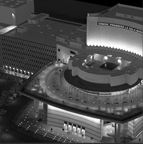
12 November 2014Ion Caramitru, Director-General of the I.L. Caragiale National Theatre of Bucharest, participated in a ribbon-cutting ceremony marking the opening of the NTB building, along with Prime Minister (and Interim Minister of Culture) Victor Ponta. Also present at the event were former Prime Minister Calin Popescu-Tariceanu and former Minister of Finance Sebastian Vladescu, who contracted the loan for the renovation of the instituion during their mandate, and former Minister of Culture, Kelemen Hunor. The event - which was organised under the auspices of the Prime Minister’s Office and the Ministry of Culture – was highly publicized by the written and audiovisual media, which transmitted detalied reports from the scene. We remind that the I.L. Caragiale National Theatre of Bucharest has been the subject of extensive rehabilitation and restauration works (started in 2011), which are coming to an end: the reception is due the 30th of November 2014, after which the constructor has three more months at his disposal for the finishing touches of the project. The stage of the Great Hall will become functional only after all the technical mechanisms have been rigorously tested. We reproduce here the full statement of Ion Caramitru, given on the 10th of November 2014: [...The building dates from...] Gheorghiu-Dej’s time and it was inaugurated in 1973. For those of you who may not know, before the construction of the theatre, on this location stood the Krately Circus. Construction began jointly with the underground parking and the InterContinental Hotel. Thus, all the utilities were shared, which was initially a problem for the reconstruction, one which we managed to overcome. After that, as you probably know, there was the 1977 earthquake which the building, as you see it, survived unharmed, then, in 1978, a great fire destroyed the Great Hall. Once the reconstruction of the Great Hall began, the building was modified at the order of Nicolae Ceausescu. The Great Hall was extended – Ceausescu wanted 1500 seats, but only 1200 were possible, so another hall was built bellow it, the Amphitheatre Hall, with a capacity of 300 seats, but which no longer exists, as it lacked the specific utilities for the functioning of the stage. In addition, they built that now-infamous presidential lodge and the hall had to be extended and heightened. For this purpose, the lateral seismic resistance systems were eliminated, more precisely, four 80-centimetres-wide diaphragms, which meant that the hall lost its acoustic, its intelligibility and in fact its visibility. (What you will see now is the full return to the original design of the Great Hall). Then, there was also the addition of the facade (which we cannot see in the present, it was the first to be demolished) weighing 1400 tons, out of which 70 per cent rested on the undergroung parking (therefore on thin, fragile ground). This means that the main reason for the investment in this objective was the need for seisimic consolidation. The two important expertises, one which took place before my arrival here and one after 2005, a counter-expertise, clearly showed that in the event of a 6.5-degree earthquake, the entire building would have collapsed, buried in the parking. At this moment, you are in perfect safety, as the reconstructed building has a resistance for an 8-degree earthquake on the Richter scale, which has never happened before and hopefully will never happen. Aside from the reconstruction, what is personally significant for me is the fact that the first demolition of a communist edifice happened here. The North Korean facade ordered and brought by Ceausescu has disappeared, and the beauty of the building has returned to the formula you can see now, thanks to our architect, Prof. Dr. Romeo Belea, the artisan and the copyright holder of the project. Everything has been rebuilt, the interior has gained new functions and there are 4 new halls. The theatre will have in total 7 halls, one of them on top of the building (on the roof), functioning during the summer, and one which, for several months, has been at the exclusive use of the young experiment in the Romanian theatre. More exactly, the Small Hall is at the disposal of young, unemployed artists who put forward projects – until now, there have been four premieres, as part of the 9G programme: the National Theatre for the New Generation of artists. I wish to thank all those who have contributed with their political will and with the necessary fonds. These important works or restoration and recovery representing historical monuments, or presenting national importance, such as the National Library or the National Theatre, were initiated during the Tariceanu government at the idea of the then-Minister of Finances, Sebastian Vladescu. They obtained a loan in very favourable conditions, amounting to one quarter of a billion euros, dedicated exclusively for culture. For those of you who do not know, the money was invested in the National Library, Bucharest National Theatre, Iasi National Theatre, Iasi Palace of Culture and other cultural sites. Of course, the rigorous conditions of such a loan engage the government to participate in parity with budgetary funds. This project has undergone five successive governments, each of whom has been open to it. Therefore, here we are now, in the National Theatre’s most beautiful period of existence, a blissful moment for myself, my colleagues and the Theatre’s admirers, who are glad to finally enter this building. I would like to thank Mr. Prime Minister Ponta for paying special attention to this site. It is his fourth visit on the site, he has been a witness to all the successive steps, he was won over by the beauty of this project and helped us, and will help us further. Thank you to all those who contributed to the project, the participating governments, including those from the Ministry of Finance, who initially showed a strong resistance to the investments, but who were eventually convinced, so that we can finally take part in this beautiful anniversary moment! Many thanks to the press for being with us and, through you, to the public and the Romanian citizens, who will soon be able to see what you have seen today.
Buy Nothing Day Premiere
31 October 2014A new stage play from the young team of 9G Program held by The National Theater of Bucharest entered the repertory of the theater. The ProDrama Association and the “I. L. Caragiale” National Theater invite you on Wednesday, 5 November 2014, 20:00 hours, to “Buy Nothing Day” by Kim Atle Hansen, directed by Horia Suru, in The Small Hall of the Theater. “Buy Nothing Day” is a fresh show which feels the young generation’s pulse in a brave and witting manner. Loaded with vital messages from the present-day social, political and economical spheres, “Buy Nothing Day” tells us about the change that emerges from every individual. The play makes a call to humor (without drifting into sarcasm), activism (with no suggestion of extremism) and to contemporary, scintillating artistic solutions in terms of sound, set and design. Petra (Ilinca Hărnuț) and Andrei (Rolando Matsangos) want to draw attention over consumerism and the exploitation of Third Word workers. Kati (Cristina Găvruș) and Irina (Olivia Alexandra Niță) want to become stars by singing at a “Save the Planet” event. Toma (Andrei Morariu) and Petru (Emil Măndănac) want to protest to improve the living conditions from the nursing home they work at. Ana (Simona Cuciurianu) wants to be more than just a clothes shop assistant. Their paths meet at the mall. This visit will change their lives. Kim Atle Hansen is a Norwegian play writer, actor and activist, author of several plays about problems of today’s society. He works at Norske Theater, and “Buy Nothing Day” is his most known play, set so far in the UK, Brazil, Italy, The USA and Russia. “This text is destined rather to a performative convention than a type of emotionally motivated game” “A lot of people have protested in the streets the last years. The economical crisis and the austerity measures, Roşia Montană and Raed Arafat have taken to the streets thousands of Romanians, old and young, hipsters and white collars, leftists and rightists. It is essential to understand how important the right to freedom of speech and protest is in a democratic society. I can’t highlight enough this aspect. I think it’s equally important, though, to push people towards information and tolerance. Psychotic derailments such as armed attacks in schools, malls and other public spaces are due to lack of education and unilateral fierceness. I am very pleased to see that, after the first 5 representations at The National Theater, the reactions have been positive and the message of the play reaches the audience.” This is a stage play about young people, social and political implication, naivety and principles. What kind of consequences could such implication have and what risks are we ready to take? Translated by: Podaru Gina MTTLC, University of Bucharest